

Why Your Saltwater Aquarium Filter Choice Matters
Saltwater tanks do not necessarily need a completely different type of filter, but they do need marine-compatible filtration suited to the tank and livestock. Saltwater is more corrosive than freshwater, marine livestock can be sensitive to poor water quality, and the filter needs to support clean, stable water without making maintenance harder.
For most hobbyists, that means choosing equipment that can handle marine use and combining mechanical, biological and, where appropriate, chemical filtration. Reef systems may also benefit from extra equipment such as a protein skimmer, but a skimmer does not replace the main filtration system.
I am Nemo Sulaiman, part of the eCommerce and warehouse team at Aquatees Fishland. Over the past two years, I have helped customers choose fish, equipment, and products, and I have found that one of the biggest misconceptions when moving from freshwater to marine aquariums is that filtration has to be completely rethought. In reality, the principles are familiar, but the demands of the system change.
What Makes Saltwater Filtration Different?
Saltwater aquarium filtration still has the same basic goal as freshwater filtration: keep the water clean, stable, and safe for livestock. The difference is that marine systems can be less forgiving when water quality drops, so the filter needs to suit the tank rather than simply move water around.
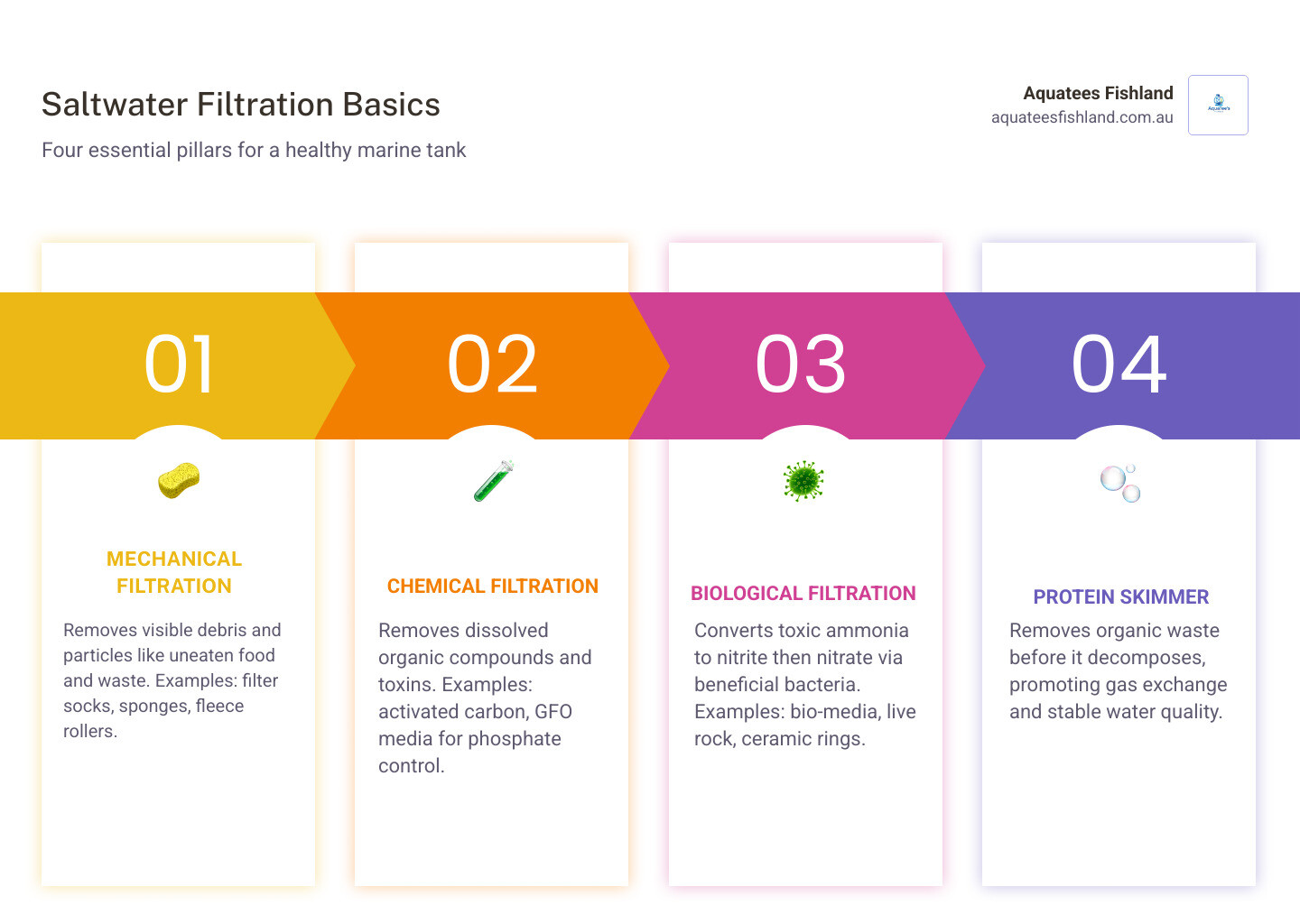
A reliable marine aquarium filtration setup usually combines three core functions:
- Mechanical filtration: Removes uneaten food, fish waste, and suspended particles. Common examples include sponges, filter floss, pads, and filter socks.
- Biological filtration: Provides surfaces for beneficial bacteria that support the nitrogen cycle by helping process ammonia and nitrite. Biological media, live rock, sand, sponge, and other established surfaces can all play a role.
- Chemical filtration: Uses media such as activated carbon when appropriate to help remove certain dissolved compounds and improve water clarity.
Does Saltwater Require a Different Filter?
A freshwater filter can sometimes be used as a filter for a marine tank, provided the manufacturer specifically confirms that it is suitable for saltwater. The important question is whether the equipment can handle marine conditions and provide enough filtration for the aquarium.
Before reusing or buying a filter, check for saltwater-compatible materials, manufacturer-approved moving parts, suitable flow for the aquarium size, enough media capacity, easy cleaning access, and suitability for the livestock being kept.
Avoid assuming that every freshwater filter is safe for saltwater use. Product documentation is more reliable than broad rules about one specific material being required in every case.
What Type of Filter Does a Saltwater Aquarium Need?
There is no single best filter for saltwater aquarium setups. The right saltwater tank filter depends on tank size, fish and invertebrates, fish-only versus reef setup, bioload, available space, and how often you are prepared to maintain the equipment.
Hang-on-back Filters
A hang-on-back, or HOB filter for saltwater aquarium use, can suit smaller marine aquariums, beginner setups, and nano tanks where straightforward filtration and easy access are priorities. These filters hang on the back of the aquarium, keep media accessible, and can usually hold mechanical, chemical, and biological media.
Check that the model is approved for marine use and has enough media space for the livestock level. A HOB filter may be practical for a lightly stocked fish-only tank, but it may not be enough on its own for a larger or equipment-heavy reef system.
Canister Filters
Canister filters can suit some larger or more heavily stocked saltwater aquariums where greater media capacity is helpful. They can hold mechanical, biological, and chemical media in separate baskets, making them flexible for hobbyists who want more filtration volume than many compact filters provide.
Because canister filters trap waste inside a closed unit, they need regular cleaning so trapped detritus does not contribute to rising nutrients. The canister filter guide can help you understand the format before choosing a marine-safe model.
Sump Filtration
A sump is not technically a filter by itself. It is a separate chamber or tank, usually below the display aquarium, that creates space for filtration and equipment. Sumps are often used on larger marine systems and reef aquariums because they add water volume and keep equipment out of the main display.
Depending on the setup, a sump may house filter socks or rollers, biological media, a protein skimmer, reactors, heaters, probes, and the return pump. This makes it useful for hobbyists who want a more flexible filtration system, but it is not mandatory for every small saltwater aquarium.
Do You Need a Protein Skimmer?
Not every saltwater aquarium needs a protein skimmer, but skimmers can be useful in many marine and reef systems. A protein skimmer is not a replacement for the aquarium filter. It helps remove dissolved organic compounds before they break down further, while also supporting gas exchange.
How to Maintain an Effective Saltwater Filtration System
Good saltwater aquarium filtration is not only about choosing a filter box or pump. The supporting parts of the system should help a marine-compatible filter do its job, but they should stay secondary to the main decision: matching the filter to the tank and livestock.
Biological Filtration
Beneficial bacteria help process ammonia and nitrite as part of the nitrogen cycle. Live rock, sand, sponge, ceramic media, and other established surfaces can support those bacteria, but they are there to strengthen the filtration plan rather than turn it into a separate topic.
If biological media becomes clogged, rinse it gently in old aquarium water rather than scrubbing everything clean under untreated tap water. This helps preserve useful bacteria while keeping flow through the media clear.
Water Movement
Water movement supports filtration by helping move waste towards the filter, reducing stagnant areas, and improving gas exchange. It should be matched to the filter, livestock, aquascape, and overall circulation design rather than treated as one universal turnover number.
Many hobbyists use the main filter for basic turnover and add wavemakers or circulation pumps only where broader movement is needed.
RO/DI Water
RO/DI water is not a substitute for aquarium filtration. It is source-water preparation used before salt is mixed and added to the aquarium, which can help where tap water contains nitrate, phosphate, metals, or other dissolved impurities.
Reef aquariums and sensitive marine setups often benefit from RO/DI water, but the exact need depends on local tap water, livestock, salt mix, and risk tolerance. Keep it as supporting context for stable filtration, not the central answer to choosing a saltwater tank filter.
Saltwater Filter Maintenance
Saltwater filter maintenance should keep the filter clear and effective without disrupting useful biological surfaces.
A practical routine includes:
- Inspecting and cleaning mechanical media frequently so trapped waste does not build up.
- Rinsing biological media gently in old aquarium water only when it becomes clogged.
- Replacing chemical media according to the manufacturer’s recommended lifespan.
- Checking pumps, impellers, and intakes for salt creep, deposits, or reduced flow.
- Monitoring key water parameters so filtration problems are caught early.
The best schedule varies depending on tank size, livestock, feeding, filtration, substrate, and water-test results.
Saltwater Aquarium Filter FAQs
Can I use a freshwater filter in a saltwater aquarium?
Yes, you can use a freshwater filter in a saltwater aquarium if the manufacturer confirms it is suitable for saltwater and it provides appropriate filtration for your setup. Check saltwater compatibility, corrosion resistance, impeller and shaft suitability, media capacity, flow, and ease of cleaning before using it on a marine tank.
What is the best filter for a saltwater aquarium?
The best filter for a saltwater aquarium depends on tank size, livestock, whether the setup is fish-only or reef, available equipment, and maintenance preferences. A small fish-only tank may suit a marine-safe HOB or canister filter, while a larger reef system may benefit from a sump with extra equipment.
Do saltwater tanks need a protein skimmer?
Saltwater tanks do not all require a protein skimmer, but skimmers can be useful in many marine and reef aquariums. They help remove dissolved organic compounds and support gas exchange, especially in larger systems or tanks with heavier feeding.
Do saltwater tanks need a sump?
No, saltwater tanks do not always need a sump. Smaller marine aquariums can use other filtration methods, while sumps become more useful as systems get larger, more heavily stocked, or more equipment-intensive.
How often should I clean a saltwater aquarium filter?
Clean a saltwater aquarium filter often enough to stop trapped waste from building up. Mechanical media should be inspected and cleaned frequently, biological media should be rinsed gently only when needed, chemical media should be replaced according to the product’s lifespan, and pumps or impellers should be checked regularly.
Can I use tap water in a saltwater aquarium?
Tap water may be usable in some situations, but it depends on the local water supply and the livestock being kept. When making saltwater, many hobbyists use RO/DI water before adding marine salt mix. For evaporation top-ups, replace the evaporated water with freshwater, not more saltwater, because evaporation leaves dissolved salts behind.
So, Do Saltwater Tanks Need Special Filters?
Saltwater tanks do not necessarily need a completely different kind of filter, but they do need marine-compatible filtration suited to the tank size, livestock, and maintenance routine. That is the main decision: choose equipment that can handle saltwater and support the animals being kept.
The most important takeaways are simple:
- Choose marine-compatible equipment rather than assuming any freshwater filter will cope with saltwater.
- Match the filter to the livestock, tank size, bioload, and type of marine setup.
- Keep biological filtration, water movement, RO/DI water, and maintenance as supporting parts of that main filtration decision.
If you are setting up a saltwater aquarium and are not sure which filtration option suits your tank, explore Australian aquarium supplier Aquatees Fishland’s aquarium filters and aquarium care products to find equipment that fits your setup.