

UV Tank Filter Guide: When This Equipment Can Help
UV tank filter equipment is usually an optional water-treatment tool, not a replacement for good filtration or regular maintenance. Cloudy water or green water can appear even when a tank has a filter and a routine care schedule, and UV sterilisation may help by treating water as it passes through a protected UV-C chamber.
A UV steriliser can support aquarium water clarity by affecting certain free-floating algae, bacteria, and microorganisms in the water column. UV filters used in aquariums and ponds are commonly described as tools for reducing free-floating microorganisms as water passes the lamp, although results depend on exposure, flow and maintenance. See this external overview of UV filters for fish tanks and ponds for another plain-English explanation.
It cannot clean waste, balance nutrients, or treat every fish health problem, so the real question is whether your tank has the kind of recurring issue UV equipment is designed to address.
In one common Aquatees Fishland customer scenario, a hobbyist has already improved feeding and water changes but still sees recurring green water. In that kind of case, I often explain that a UV tank filter may be worth considering only after the basic filtration and maintenance causes have been checked.
I am Naim Ibn Nahshid, also known as Nemo Sulaiman, and I am part of the eCommerce and warehouse team at Aquatees Fishland. Over two years of helping customers choose fish, aquarium equipment, and products, I have often seen UV sterilisers come up when hobbyists are trying to understand water quality, filtration, and whether extra equipment is genuinely useful for their setup.
What Does an Aquarium UV Steriliser Do?
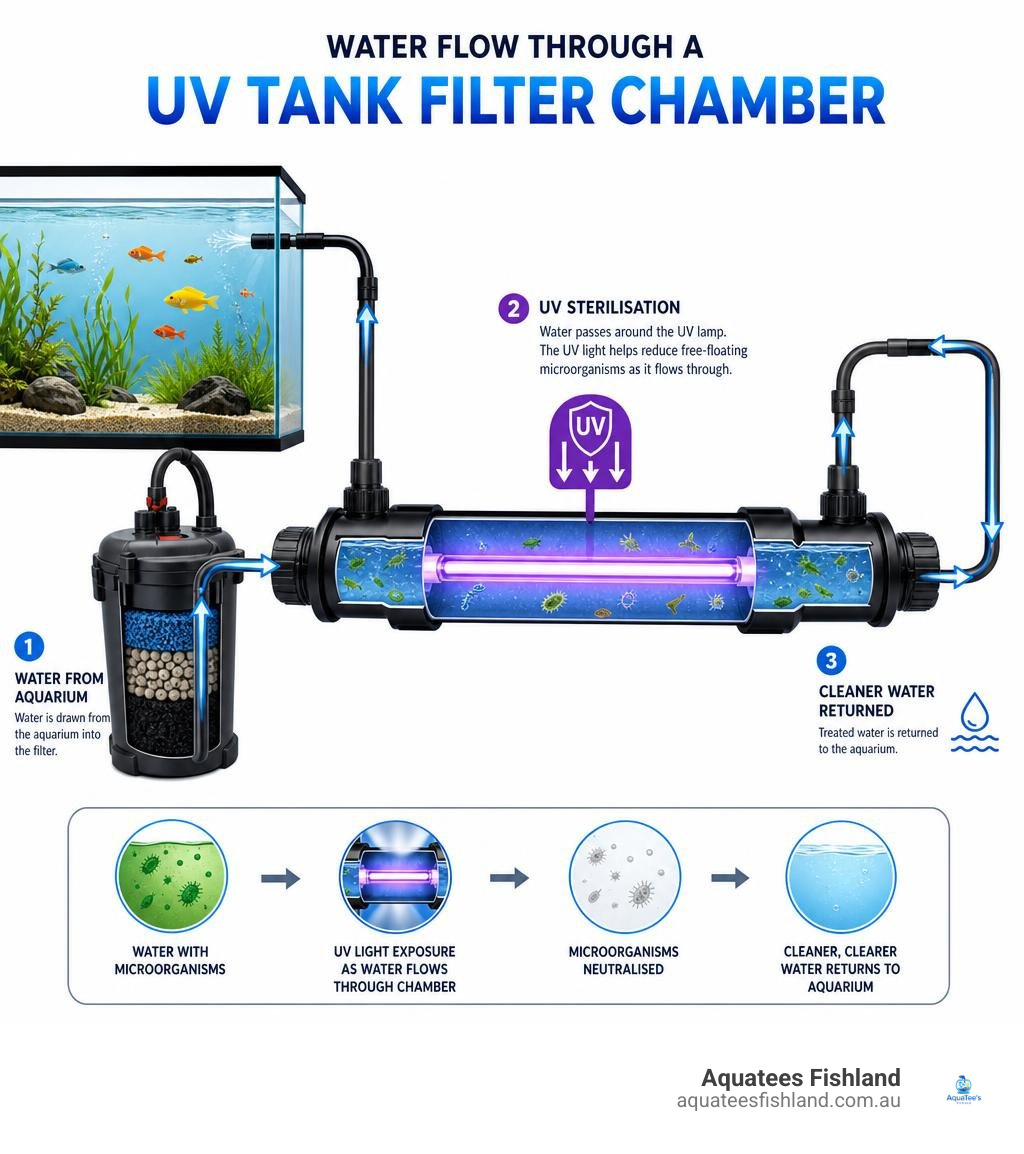
An aquarium UV steriliser treats aquarium water as it passes through a unit that contains UV-C light. The exposure can affect certain microorganisms floating in the water, which may help with green water, some biological cloudiness, and overall aquarium water clarity.
How Does a UV Steriliser Work?
The basic process is simple: aquarium water moves into the UV chamber, receives UV exposure, then returns to the aquarium. The treatment only affects organisms and particles passing through the steriliser, so algae attached to glass, décor, plants, or substrate are not directly treated.
Is a UV Steriliser the Same as an Aquarium Filter?
No, a UV steriliser is not the same as an aquarium filter. A filter removes or processes waste, while a UV steriliser provides additional water treatment.
| Aquarium filter | UV steriliser |
|---|---|
| Removes or processes aquarium waste | Treats water passing through the UV chamber |
| Supports biological filtration | Provides UV exposure to the water |
| Helps maintain the nitrogen cycle | Can help control certain free-floating microorganisms |
| Forms part of routine aquarium filtration | Acts as an additional water-treatment tool |
Why Might You Need a UV Steriliser?
You may benefit from a UV steriliser if your aquarium regularly experiences green water, persistent cloudiness, or recurring issues with free-floating microorganisms. It is most useful as an additional tool when the cause suits UV treatment, not as a shortcut around core aquarium care.
Your Aquarium Keeps Developing Green Water
Green water is usually caused by tiny suspended algae that make the whole aquarium look tinted or pea-soup green. A UV steriliser for green water can often help because the affected algae pass through the UV chamber with the water.
Lighting, nutrients, feeding, stocking, and water-change habits still matter. If those causes are not managed, the same green-water problem may return after the UV unit clears the water.
Your Aquarium Water Remains Cloudy
A UV steriliser for cloudy water may help when the cloudiness is linked to suspended biological material. It may not help much if the cloudiness comes from dust, disturbed substrate, poor mechanical filtration, or an unfinished aquarium cycle.
You Want Additional Water Treatment
Some hobbyists use an aquarium UV steriliser because they want an extra layer of water treatment alongside their main filter. This can be reasonable for particular setups, but many stable home aquariums can run successfully without UV sterilisation.
What Can an Aquarium UV Steriliser Help With?
An aquarium UV steriliser can help with free-floating algae, some microorganisms in the water column, and clearer-looking water when the unit is correctly matched to the aquarium. Results depend on wattage, flow rate, water clarity, stocking, maintenance, and the manufacturer's recommendations.

Free-Floating Algae
UV steriliser algae control is most relevant to algae suspended in the water. It is less relevant to algae growing on aquarium glass, rocks, wood, décor, or substrate because that growth does not pass through the chamber.
Some Free-Floating Microorganisms
UV exposure can affect certain microorganisms in the water column, depending on exposure time and flow rate. Avoid treating UV sterilisation as something that removes every parasite, bacteria, or disease risk in an aquarium.
Water Clarity
Reducing some suspended organisms can contribute to clearer-looking aquarium water. Clearer water may also help UV light work more effectively because fewer particles can interfere with exposure inside the unit.
Do You Actually Need a UV Steriliser for Your Aquarium?
Not necessarily. Many well-maintained aquariums can operate successfully without UV sterilisation, especially when stocking, feeding, filtration, and maintenance are already well matched.
You May Want One If...
- You regularly experience green water.
- Your aquarium has recurring water-clarity problems.
- You want an additional layer of water treatment.
- Your existing filtration and maintenance routine are not resolving a specific water-quality issue.
- Your setup and manufacturer recommendations are compatible with UV equipment.
You May Not Need One If...
- Your water is consistently clear.
- Your aquarium is appropriately stocked.
- Your filtration is suitable for the tank.
- You maintain the aquarium regularly.
- You are not experiencing the problems a UV steriliser is designed to address.
What a UV Steriliser Cannot Replace
A UV steriliser cannot replace the main systems that keep an aquarium healthy. It treats water moving through the unit, but it does not remove waste, maintain the nitrogen cycle, or correct poor maintenance habits.
It Doesn't Replace Your Aquarium Filter
Filtration remains fundamental because mechanical and biological media remove particles and support beneficial bacteria. If you are planning a broader filtration upgrade, Aquatees Fishland's aquarium filter systems range is a better starting point than treating UV as a standalone fix.
It Doesn't Replace Water Changes
Routine water changes help manage nitrate, dissolved organics, and general aquarium stability. UV treatment does not remove those substances from the water.
It Doesn't Remove Fish Waste
Fish waste, leftover food, and plant debris still need mechanical filtration, substrate cleaning, and appropriate husbandry. UV light is not a physical waste-removal system.
It Doesn't Fix Poor Aquarium Maintenance
A UV unit should not be used to cover overstocking, excess feeding, poor filtration, neglected maintenance, or incorrect water parameters. Those underlying causes should be corrected first.
It Doesn't Treat Every Fish Health Problem
UV acts only on water passing through the unit. Not every organism affecting a fish is free-floating long enough to be exposed, so UV sterilisation should not be treated as a universal fish-health treatment.
What Makes a UV Steriliser Effective?
A UV steriliser is most effective when wattage, water flow rate, water clarity, lamp condition, and installation all suit the intended use. Manufacturer guidance should come first because different units are designed for different aquarium sizes and flow rates.
UV Tank Filter Wattage
UV steriliser wattage matters because stronger lamps can provide more exposure, but wattage should not be the only factor. A poorly matched flow rate can reduce performance even when the wattage looks suitable.
Water Flow Rate
Aquarium UV steriliser flow rate matters because water needs enough exposure time inside the chamber. Faster flow can reduce contact time, while slower flow may increase exposure depending on the unit and intended application.
Water Clarity
Very dirty or particle-heavy water can interfere with UV exposure. Good mechanical filtration and routine maintenance help water pass through the UV unit more effectively.
UV Lamp Condition
UV lamps lose useful output over time, even when they still produce visible light. Follow the manufacturer's replacement schedule and clean the quartz sleeve or protective cover when recommended.
Correct Installation
Correct installation helps keep UV-C light contained and water moving through the unit as intended. Avoid risky DIY modifications and follow the product manual for placement, plumbing, cleaning, and replacement parts.
Aquarium UV Steriliser Product Options
Some aquarium UV sterilisers are standalone inline units, while others are built into filtration equipment. Choose based on your aquarium size, existing filter setup, intended use, and the manufacturer's flow-rate and installation guidance.
HAQOS UV-H36 Aquarium & Pond UV Sterilizer Clarifier
The HAQOS UV-H36 is a 36-watt UV steriliser clarifier designed for aquarium and pond use. It may suit hobbyists who want a dedicated UV unit with flexible installation options, including inline and hang-on applications, provided the setup matches the product instructions.
_compressed.webp?alt=media&token=98e94e87-68ce-482c-8cd0-1ce3efa5e50a "user-inserted")
Key features include a 360-degree rotatable body design, multiple hose-connector options, transparent water valves, an external electronic ballast, and versions available in 9W, 18W, and 36W. As with any UV unit, it should be used on an established aquarium or pond and kept supplementary to biological filtration.
Dymax UV-FLO 5W
The Dymax UV-FLO 5W is a compact inline UV steriliser designed to connect along water hoses, including canister filter hoses, overhead filter lines, or sump return pump hoses. It may suit smaller setups or hobbyists who want a quick-connect UV option for green water or suspended biological cloudiness.
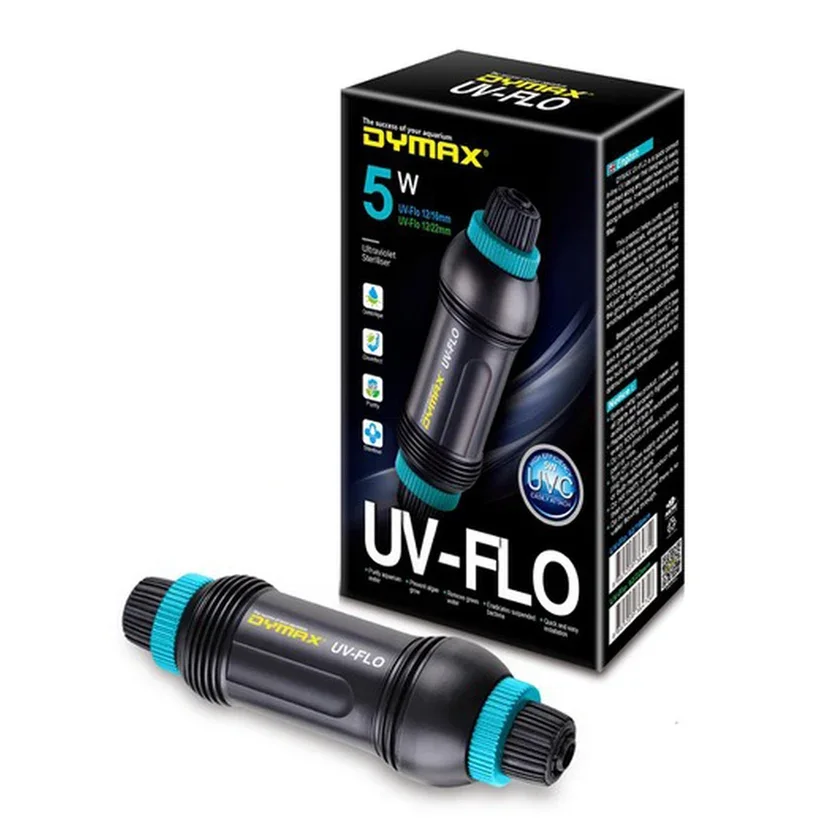
Its condensed design redirects water around the bulb to support contact time for water clarification. Check hose compatibility, flow rate, and installation instructions before adding it to an existing filtration system.
Periha EC External UV Canister Filters
Periha EC External UV Canister Filters combine mechanical, biological, and chemical filtration with a built-in UV lamp. This type of product may suit aquariums where the main goal is a broader filtration upgrade with UV support included, rather than adding a separate UV-only unit.
The canister design can hold common filtration media such as sponge, ceramic noodles, bio balls, and carbon, while the UV lamp adds extra treatment for water passing through the filter. Match the model to the tank volume, media needs, freshwater or saltwater setup, and maintenance access before choosing it.
How to Choose an Aquarium UV Steriliser
Choosing an aquarium UV steriliser starts with the aquarium's size, the reason you want UV treatment, and the recommended flow rate for the unit. The right UV tank filter choice should fit your existing setup without replacing the filter or maintenance routine.
Consider Your Aquarium Size
Tank volume is one of the first details to check because UV units are usually rated for particular aquarium or pond sizes. Oversized or undersized equipment may not suit the intended use.
Check the Recommended Flow Rate
Flow rate can be just as important as wattage. Compare the steriliser's recommended flow range with your pump, canister filter, or sump return before buying.
Consider Your Intended Use
A hobbyist targeting green water may not need the same setup as someone seeking additional water treatment in a heavily stocked aquarium. Choose based on the actual problem rather than the idea that every tank benefits from UV.
Check Compatibility With Your Existing Setup
Consider your existing filtration, hose size, plumbing space, power access, and maintenance access. Inline units, internal units, and built-in UV filters can suit different aquarium layouts.
Consider Maintenance and Replacement Parts
A UV light aquarium steriliser needs lamp replacements and cleaning access. Before choosing a model, check whether replacement lamps, seals, and sleeves are available for that unit.
How to Use a UV Steriliser Safely
Use a UV steriliser safely by following the manufacturer's instructions and keeping UV-C light contained inside the unit. Direct exposure to UV-C light can be harmful, so servicing should be done carefully with power switched off.
- Follow the manufacturer's installation instructions.
- Use the recommended flow rate for the unit.
- Keep UV-C light contained within the housing.
- Do not look directly at an exposed UV-C lamp.
- Maintain the unit according to the manual.
- Replace lamps, seals, and sleeves when recommended.
Aquarium UV Steriliser FAQs
Does a UV steriliser affect beneficial bacteria?
A UV steriliser is unlikely to disrupt established biological filtration because most beneficial bacteria live on filter media, substrate, décor, and aquarium surfaces rather than floating in the water. It can affect some free-floating bacteria that pass through the UV chamber, so it should be used as a supporting water-treatment tool rather than a replacement for a mature filter.
How long should an aquarium UV steriliser run?
An aquarium UV steriliser should run according to the manufacturer's recommendations and the reason you are using it. Some units may be designed for ongoing operation, while others may be used for a specific water-clarity issue, so check the manual before setting a schedule.
What size UV steriliser do I need for my aquarium?
The right UV steriliser size depends on tank volume, UV wattage, flow rate, water clarity, and whether you are targeting green water, general clarity, or additional water treatment. Use the product rating and the selection points above to match the unit to your aquarium rather than choosing by wattage alone.
Can a UV steriliser be used with an aquarium filter?
Yes, a UV steriliser can be used with an aquarium filter when the setup, hose size, flow rate, and manufacturer instructions are compatible. The filter still handles mechanical and biological filtration, while the UV unit adds water treatment for organisms passing through its chamber.
How often does an aquarium UV lamp need replacing?
An aquarium UV lamp should be replaced on the schedule recommended by the manufacturer, even if the bulb still produces visible light. UV output can decline over time, so lamp replacement, sleeve cleaning, and seal checks are important parts of keeping the unit effective.
Choosing a UV Tank Filter for Your Aquarium
A UV tank filter setup can be useful when the goal is clearer water, green-water control, or additional treatment of free-floating microorganisms. It is not essential for every aquarium, and it should not replace filtration, water changes, safe stocking, or routine maintenance.
The right unit depends on your aquarium size, intended use, flow rate, lamp condition, and installation requirements. If UV equipment suits the issue you are trying to solve, use it as part of a balanced aquarium-care routine and follow the manufacturer's instructions closely.
- Explore aquarium filter systems for filtration foundations that work alongside UV equipment.
- Browse aquarium water care products for routine maintenance support.
- View home fish tanks if your setup needs more space or a better long-term aquarium plan.