

Water Testing & Tank Health Problems: Find the Cause Before Fish Feel It
Water Testing & Tank Health Problems are straightforward to manage when aquarists measure parameters rather than guessing the cause of livestock distress. Testing water clarifies whether biological disruptions, organic waste, or mineral shifts affect aquarium balance.
For rapid monitoring, Fritz 6 in 1 Test Strips identify trends quickly, while biological supplements like FritzZyme 7, FritzZyme 9, FritzZyme Trace, and FritzZyme TurboClean from the Fritz Aquatics collection support biofilter health.
Key Takeaways
- Routine water testing identifies invisible dissolved toxins before fish show physical distress.
- Ammonia and nitrite must remain at 0.0 ppm to avoid toxicity and gill damage.
- Nitrate monitoring tracks overall waste accumulation to guide water change schedules.
- Carbonate hardness (KH) stabilises pH levels, protecting against rapid biological acidification.
- Gradual corrective water adjustments protect delicate beneficial bacteria and reduce livestock stress.
I am Nemo Sulaiman, part of the eCommerce and warehouse team at Aquatees Fishland, and have spent the past two years helping customers choose the right fish, aquarium equipment, and products for their setups. My day-to-day experience shows that identifying water chemistry shifts early makes resolving tank health challenges straightforward and prevents unexpected livestock losses.
Diagnosing Water Testing & Tank Health Problems Across Key Parameters
Regular water quality monitoring distinguishes between acute chemical toxicity, chronic waste accumulation, and baseline parameter fluctuations. Fish adapt to gradual mineral changes, but sudden chemistry swings cause severe biological shock. Crystal-clear water does not guarantee safety.
Scientific research indexed in The Handbook of Environmental Chemistry highlights that un-ionised ammonia penetrates biological membranes to disrupt cellular respiration at concentrations as low as 0.02 mg/L, remaining entirely invisible in clear water.
The reference table below outlines baseline targets and diagnostic symptoms for freshwater home aquariums:
| Parameter | Baseline Target Range | Diagnostic Symptoms (Too High) | Diagnostic Symptoms (Too Low) |
|---|---|---|---|
| Ammonia | 0.0 ppm | Surface gasping, red gills, lethargy | N/A (0.0 ppm is optimal) |
| Nitrite | 0.0 ppm | Rapid gill movement, brown gills, clamped fins | N/A (0.0 ppm is optimal) |
| Nitrate | < 20–40 ppm | Chronic lethargy, dull colours, excess algae | Stunted live plant growth |
| pH | 6.5–7.5 (species-dependent) | Excess mucus, increased ammonia toxicity | Acidosis, biofilter stalling (< 6.0) |
| Carbonate Hardness (KH) | 3–8 dKH (50–140 ppm) | High persistent pH, excess buffering | Rapid pH fluctuations, crash risk |
| General Hardness (GH) | 4–12 dGH (70–215 ppm) | Osmoregulatory stress in soft-water fish | Snail shell erosion, shrimp moulting failure |
| Temperature | 24°C–26°C (tropical standard) | Low dissolved oxygen, elevated respiration | Sluggish behaviour, suppressed immunity |
Ammonia and Nitrite: Identifying Acute Water Testing & Tank Health Problems
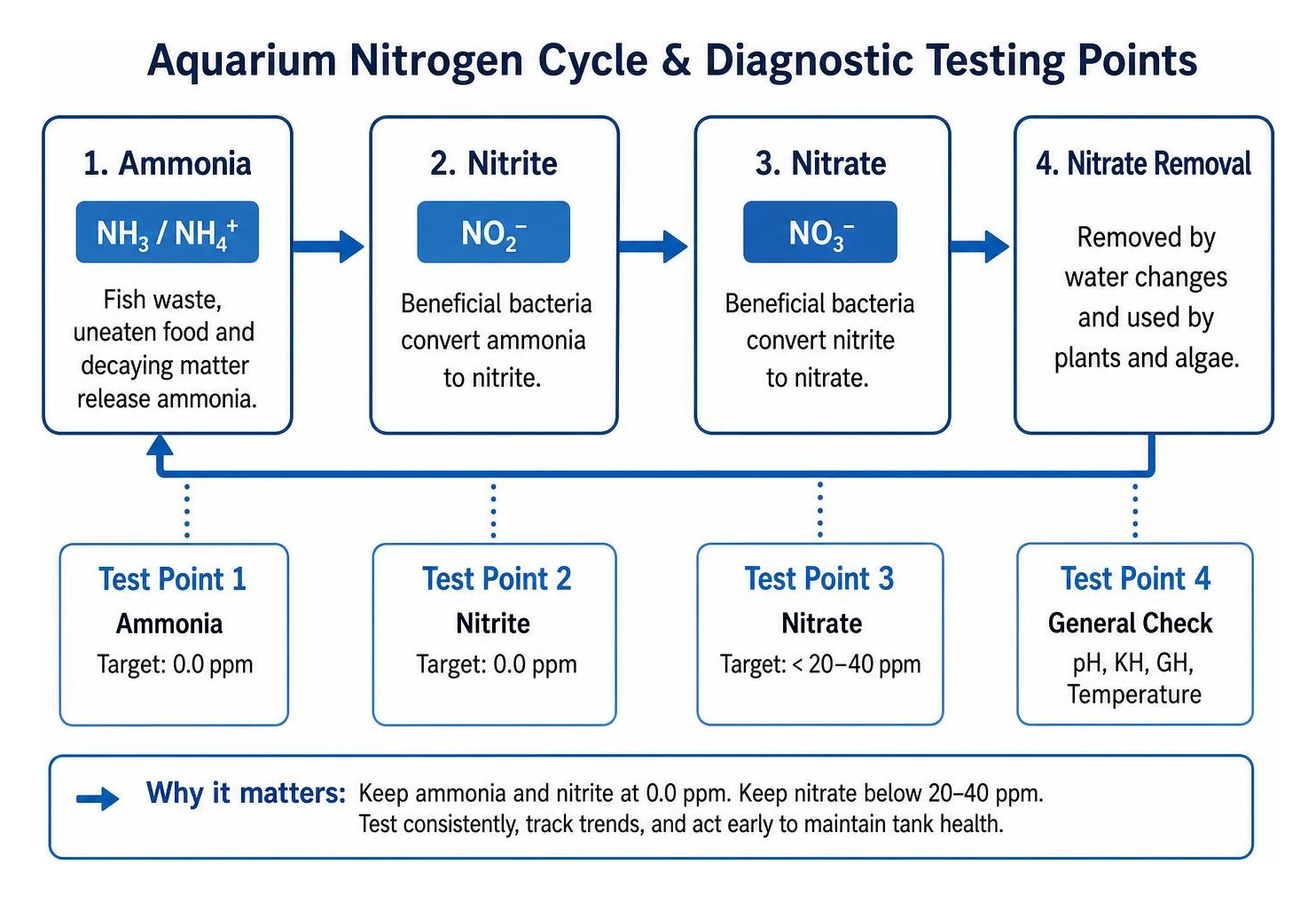
Ammonia and nitrite spikes represent acute chemical hazards that disrupt oxygen transport and respiration in aquatic life. Fish excrete ammonia through their gills, which exists in water in equilibrium between toxic un-ionised ammonia and less harmful ammonium. As pH and temperature rise, a higher fraction shifts into un-ionised ammonia. Any total ammonia reading above 0.25 ppm requires swift intervention.
Nitrite develops as autotrophic bacteria oxidise ammonia. Absorbed across the gills, nitrite oxidises haemoglobin into methaemoglobin, causing brown-blood disease and suffocation.
Liquid test kits can give you a more reliable reading when you need to check your aquarium water closely. The Fritz Ammonia Test Kit is easy to use: add 5 mL of aquarium water, add the two test solutions, shake and wait five minutes for the result.
For a quicker check, Fritz 6 in 1 Test Strips can test several important water parameters at once, including pH, GH, KH, chlorine, nitrite and nitrate. They’re handy for regular checks when you want a quick overview of your water quality.
If you're cycling a new aquarium or trying to rebuild a healthy biofilter, products such as FritzZyme 7 for freshwater and FritzZyme 9 for saltwater can help introduce beneficial bacteria. FritzZyme 7 is available in several bottle sizes, from 236 mL through to 3.7 L.
FritzZyme TurboClean is another option for aquariums with built-up organic waste. It helps break down sludge and other trapped waste in the aquarium and filter.
Nitrate Accumulation: Tracking Waste Loads and Biofilter Capacity
Nitrate represents the final stage of nitrification and serves as a dependable indicator of cumulative organic waste. While less acutely toxic than ammonia or nitrite, sustained nitrate concentrations above 40 ppm cause chronic stress, suppressed immunity, and persistent algae.
Testing with the Fritz Nitrate Test Kit requires 5 mL of aquarium water, 10 drops of Solution #1, vigorously shaking Solution #2 for 30 seconds, adding 10 drops, shaking the test tube for 1 minute, and waiting 5 minutes. Managing nitrate relies on scheduled 20% to 25% weekly water changes, substrate siphoning, and live plant cultivation. Filtration must match livestock bioload, and reviewing the water filter range at Aquatees Fishland helps keepers choose suitable canister, sponge, or internal filter setups.
pH and Carbonate Hardness: Addressing Chemical Instability
Carbonate hardness (KH) provides essential buffering capacity that stabilises aquarium pH against biological acidification. Nitrification consumes dissolved carbonates while releasing acidic hydrogen ions. If KH drops below 3 dKH (approximately 50 ppm), the buffer depletes, risking a sudden pH crash that stalls beneficial bacteria and shocks livestock.
Stability is more important than chasing specific textbook figures. When adjustments are necessary, limit shifts to no more than 0.2 pH units per day using products like Fritz pH Higher, dosed at 5 mL per 76 L. Applying quality aquarium water conditioners during tap water changes neutralises chlorine, chloramines, and heavy metals, protecting biological filters.
General Hardness and Temperature: Managing Osmotic and Thermal Stress
General hardness (GH) measures dissolved calcium and magnesium ions essential for osmoregulation, snail shell development, and shrimp exoskeleton moulting. Insufficient GH leads to failed invertebrate moults, while excessively high GH causes osmoregulatory strain in soft-water species.
Water temperature governs metabolic rates in aquatic life. Elevated temperatures accelerate oxygen consumption while reducing dissolved oxygen saturation. Regular monitoring using dedicated aquarium water test kits and accurate thermometers maintains stable thermal and osmotic conditions.

Correcting Out-of-Range Results, Protecting Biofilters, and Testing Schedules
When water test results fall outside safe ranges, structured corrective actions restore equilibrium without harming beneficial bacteria:
- Perform Conditioned Water Changes: For ammonia or nitrite spikes, carry out a 30% to 50% water change using temperature-matched, dechlorinated water to dilute toxic concentrations safely.
- Protect Beneficial Bacteria: Never rinse filter media in tap water. The Aquatees Blue Activated Carbon Filter Sponge acts specifically as a carbon filter sponge, removing chemical impurities while its porous structure supports biological filtration and provides an accessible surface for nitrifying bacteria; gently rinse it only in extracted aquarium water.
- Replenish Biological Media: Dose FritzZyme 7 or FritzZyme 9 after emergency water changes or heavy filter servicing to restore disrupted bacterial colonies.
- Follow an Adaptable Testing Schedule: Test daily during new tank cycling (weeks 1 to 6) or medication treatments. Shift to weekly testing for established aquariums, monitoring pH, KH, and nitrate. Increase testing to twice weekly after adding new livestock, heavy feeding, or filter maintenance.
Aquarium Water Testing and Tank Health Management FAQs
How Often Should I Test My Aquarium Water Parameters?
New aquariums should be tested daily for ammonia, nitrite, and pH during cycling, whereas established tanks typically require testing once every one to two weeks. Daily testing during the first 4 to 6 weeks verifies when beneficial bacteria have colonised the biological filter media. Once ammonia and nitrite consistently read 0.0 ppm, weekly testing for nitrate, pH, and KH ensures stability. Aquarists should also test water immediately after adding new livestock, following major filter maintenance, or whenever fish exhibit unusual behaviour like lethargy or clamped fins.
Why Are My Fish Showing Distress When the Water Appears Completely Clear?
Fish show severe distress in clear water because toxic compounds like un-ionised ammonia, nitrite, and chlorine are completely colourless and dissolved. Water clarity only reflects low levels of suspended mechanical debris, not biological safety. Chemical stressors, including dissolved oxygen depletion or sudden pH swings, cause surface gasping and erratic swimming despite spotless water clarity. Performing an immediate liquid test panel for ammonia, nitrite, pH, and KH identifies the true chemical cause. Adding bacterial supplements, such as FritzZyme products stocked by Aquatees Fishland online in Australia, helps re-establish biological balance if testing indicates filter impairment.
What Should I Do If My Aquarium Suffers a Sudden pH Crash?
If your aquarium suffers a sudden pH crash, immediately perform a 20% to 25% water change with temperature-matched, dechlorinated water and measure your carbonate hardness (KH). Avoid large, sudden chemical adjustments, as raising pH by more than 0.2 units within 24 hours causes severe osmotic stress to livestock. Introducing measured carbonate buffers replenishes depleted buffering reserves and allows nitrifying bacteria to recover biological activity gradually over 24 to 48 hours.
How Do Liquid Reagent Test Kits Compare to Test Strips for Water Diagnostics?
Liquid reagent test kits provide maximum precision for diagnosing acute toxicity, while multi-parameter test strips offer fast routine screening. Liquid kits are ideal during tank cycling, disease outbreaks, or parameter troubleshooting where exact numerical values are critical. Test strips offer a convenient method for regular weekly checks to confirm that pH, hardness, and waste levels remain within expected baselines.
Keeping Aquarium Water Within a Healthy Range for Long-Term Tank Stability
Consistent water testing provides direct insight into the biological stability and chemical safety of your aquarium. Monitoring ammonia, nitrite, nitrate, pH, and hardness allows aquarists to identify shifting parameters before livestock experience stress or biofilters stall. Sustained water quality depends on reliable filtration, structured maintenance habits, and measured corrective adjustments whenever parameters drift.
Understanding the relationship between biological waste processing, mineral buffers, and temperature creates a stable, healthy aquatic habitat. Using accurate testing tools and quality bacterial conditioners removes guesswork and supports lasting aquarium success.
To support your testing routine and maintain steady water quality, explore these helpful resources:
- Browse our collection of aquarium water test kits and treatments to monitor essential parameters with accuracy.
- Explore mechanical and biological options in our fish tank filtration systems to maintain balanced biological capacity.
- Discover comprehensive solutions across our range of aquarium care products to support long-term aquatic stability.