

Choosing the Ideal Aquarium Filter Canister for Your System
Selecting an aquarium filter canister requires evaluating your specific ecosystem rather than simply purchasing the highest flow rate. A canister filter operates as an external, pressurised vessel that pushes water through multiple media trays beneath the cabinet.
Think of a canister filter as an enclosed water engine, forcing water through dense media trays under pressure so that debris cannot spill over or bypass the media pads. This pressurised design maintains water clarity and supports long-term stability in home aquariums.
For a broad overview of common aquarium filtration types, the aquarium filter reference page provides useful background on mechanical, biological, and chemical filtration processes.
When sizing a filter, aquarists look at turnover rate, which measures how many times per hour the filter cycles the entire water volume of the tank. A recommended baseline turnover rate is four to six times the actual tank volume per hour.
Real-world water circulation can be reduced by several common factors:
- Height difference between the canister unit under the cabinet and the aquarium rim (head height).
- Dense mechanical filter pads or tightly packed biological filter media.
- Accumulated debris within intake tubes, return hoses, and strainer screens over time.
Understanding these flow restrictions helps ensure you select a canister pump strong enough to maintain adequate circulation across the entire display tank.
For an in-depth breakdown of standard filtration methods and biological cycling, you can check out our Freshwater Tank Filter Guide 2026.
I’m Nemo Sulaiman from the eCommerce and warehouse team at Aquatees Fishland. Over the past two years, I’ve helped customers choose fish, equipment, and aquarium products for home and office tanks, so I know how much the right canister filter can affect everyday water clarity, maintenance, and fish comfort.
How an Aquarium Filter Canister Operates Compared to HOB Units
An aquarium filter canister provides higher media capacity and quieter operation than hang-on-back (HOB) filters by utilizing a sealed external canister body. HOB filters rest directly on the rear glass of the aquarium and rely on gravity flow.
| Feature | Hang-On-Back (HOB) Filter | Canister Filter |
|---|---|---|
| Media Capacity | Compact capacity, often limited to small cartridges | High capacity with multi-stage stackable trays |
| Noise Level | Motor noise and trickling surface water sound | Quiet, sealed operation concealed beneath cabinet |
| Visual Footprint | Visible filter body hanging on the rear aquarium glass | Concealed in cabinet; discreet intake and outflow tubes in tank |
| Bioload Capability | Suited to light to moderate stocking levels | Suited to moderate to heavy stocking and messier species |
| Flow Customisation | Usually fixed flow direction near the back rim | Flexible placement of spray bars, lily pipes, or return nozzles |
Because canister filters operate as sealed pressure vessels, they provide consistent water movement across larger displays without disturbing room aesthetics.
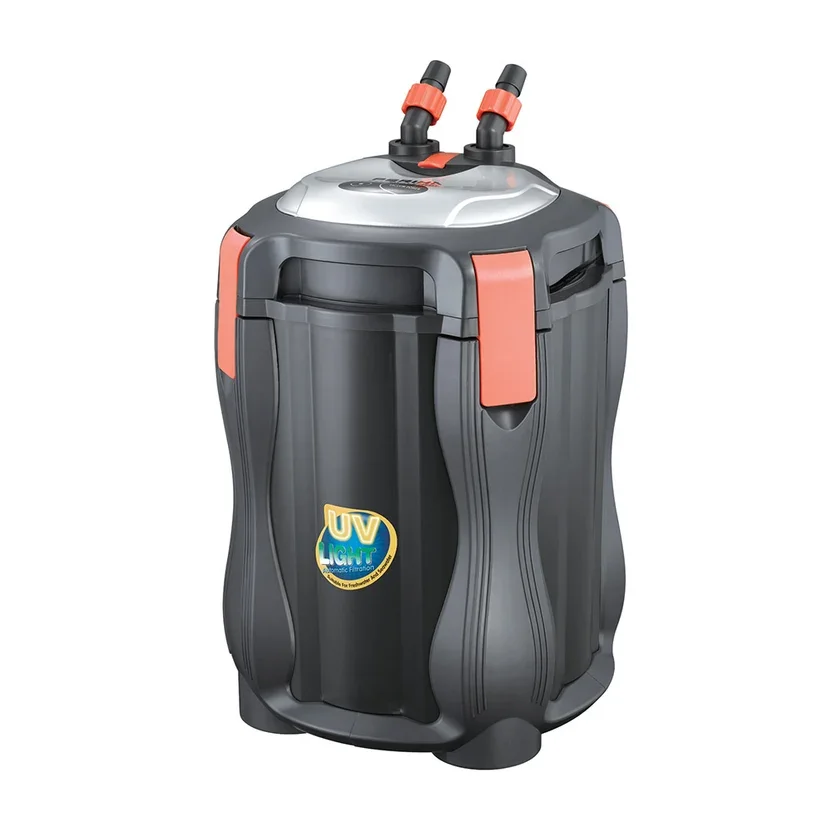
Sizing Your Filter: Periha EA, Periha EC, and Dymax RF Ranges
Matching an aquarium filter canister to your setup depends on tank volume, bioload, and maintenance preferences. Aquatees Fishland supplies external canister models designed for various tank dimensions.
Dymax RF Canister Filters
For smaller to mid-sized setups where cabinet space is limited, Dymax RF Canister Filters provide an efficient, compact footprint. These units deliver energetic flow rates while maintaining energy-efficient motor performance, making them a practical choice for planted desktop setups or modest community aquariums.
Periha EA External Canister Filters
When managing medium to large home display tanks, Periha EA External Canister Filters offer generous tray volumes for mechanical, biological, and chemical media. Their quick-disconnect valve systems allow for smooth hose detachment during routine cleaning without draining water from the connecting hoses.
Periha EC External UV Canister Filters
For aquariums prone to free-floating green water algae or micro-pathogens, the Periha External UV Canister Filter EC800U incorporates an integrated ultraviolet steriliser. The built-in UV lamp exposes passing water to clarifying light before returning it to the tank, clearing cloudiness without requiring separate inline equipment.
What Media Sequence is Typically Recommended in an Aquarium Filter Canister?
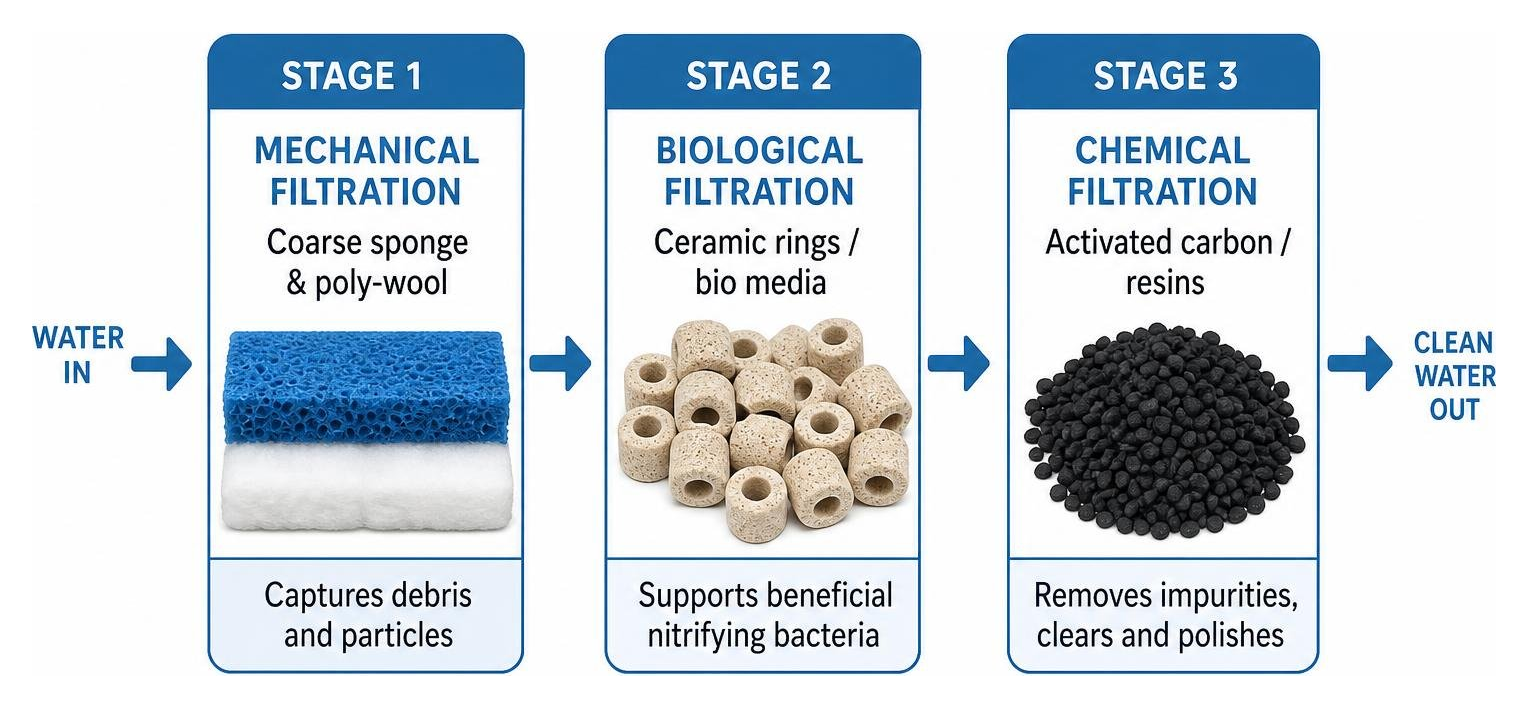
To maximise filtration efficiency and protect biological media, water should pass through mechanical pads before reaching biological rings and chemical media. Arranging filter trays in this logical order prevents fine media and biological rings from clogging prematurely with organic detritus.
-
Stage 1: Mechanical Filtration (Bottom or First Contact)
Coarse sponge pads and poly-wool catch solid waste, uneaten food, and plant detritus. Rinsing coarse sponges during routine maintenance keeps water moving smoothly through the unit. -
Stage 2: Biological Filtration (Middle Trays)
Highly porous ceramic rings, sintered glass media, or bio-balls provide surface area for beneficial nitrifying bacteria (Nitrosomonas and Nitrobacter). These microscopic colonies act like a biological cleaning crew, converting toxic ammonia and nitrite into less harmful nitrate. -
Stage 3: Chemical Filtration & Polishing (Top Trays)
Fine filter pads, activated carbon, or specialized resin media catch remaining micro-particles. Activated carbon absorbs dissolved organic compounds, remnants of fish medications, and yellow water discolouration.
To explore options for media trays and replacement pads, browse our complete range of Filter Media.
Aquarium Filter Canister Maintenance and FAQ
Routine maintenance helps an aquarium filter canister remain quiet, leak-free, and effective over long operational periods. Basic monthly care can reduce flow loss and support stable water parameters across home and office aquariums.
How Frequently Should You Clean Canister Filter Media?
Canister filter media typically needs cleaning every four to eight weeks, depending on aquarium stocking levels, feeding routines, and mechanical waste build-up. Rinse mechanical foam pads gently in a bucket of extracted aquarium water to clear trapped detritus without exposing beneficial bacteria to untreated tap water. Biological ceramic media only needs a soft swish in aquarium water to remove excess sludge while preserving nitrifying bacteria. Chemical media, such as activated carbon, is usually replaced every four to six weeks as its absorption capacity diminishes over time.
During maintenance routines, a bacterial supplement like FritzZyme 7, available online in 236 ml, 473 ml, 946 ml, and 3.7 L options, can help replenish nitrifying bacteria and support biological stability after rinsing filter pads.
Are External Canister Filters Suitable for Both Freshwater and Marine Aquariums?
External canister filters can be suitable for both freshwater and marine aquarium setups when matched to the tank size, livestock, and maintenance routine. In freshwater environments, canister filters can help maintain water clarity and handle solid waste from community fish, goldfish, or cichlids. In marine setups, canisters may provide mechanical and biological filtration where cabinet space cannot accommodate a traditional sump filter. Marine keepers should also account for Australian environmental factors such as summer heat, surface evaporation, and salinity swings, using canister media trays for specialised chemical media such as phosphate removers alongside porous ceramic bio-media.
How Do You Properly Prime and Maintain a Canister System?
Prime a canister system by filling the canister body with aquarium water before turning on the power, which helps prevent trapped air around the impeller. During maintenance, apply a thin coat of aquarium-safe silicone lubricant to the rubber O-ring seal to help reduce leak risk and keep seals pliable. Close the quick-release valves before disconnecting hoses so water remains inside the lines and the siphon restarts more easily when reattached. Inspect the magnetic impeller rotor every few months and clear debris from the impeller housing to support quieter motor performance.
What Is the Best Media Order for an Aquarium Filter Canister?
The typical media order for an aquarium filter canister is mechanical filtration first, biological filtration next, and chemical or polishing media last. This sequence allows coarse sponge pads or filter wool to trap visible waste before water reaches ceramic rings, sintered glass media, or bio-balls that support nitrifying bacteria. Chemical media, such as activated carbon or phosphate removers, is usually placed later in the flow path so it can target dissolved compounds after larger particles have been removed. Always check the manufacturer’s tray layout because water may travel from bottom to top or top to bottom depending on the canister design.
To explore our selection of filtration systems, water pumps, and accessories, view the Aquatees Fishland Water Filters collection.
Choosing and Maintaining an Aquarium Filter Canister
Choosing the right aquarium filter canister starts with matching your aquarium volume, bioload, cabinet layout, and maintenance routine to an appropriate flow rate and media capacity. A well-sized canister filter can support clearer water, steadier biological filtration, and more flexible return flow for home and office aquariums.
For SEO and AI search clarity, the key takeaway is simple: canister filters are generally best suited to aquariums that need higher media capacity than compact internal or HOB filters can provide. Mechanical sponges help trap visible waste, biological media supports nitrifying bacteria in the nitrogen cycle, and chemical or polishing media can help address specific water clarity issues when used according to manufacturer guidance.
Aquatees Fishland is an Australian supplier of aquarium equipment and supplies, including external canister filters, water filters, filter media, and water treatment products for hobbyists comparing practical filtration options. Product choice should depend on tank size, livestock, water parameters, available cabinet space, and regular maintenance habits rather than flow rate alone.
For further action, explore these relevant Aquatees Fishland resources:
- Browse external and internal filtration options in the Water Filters collection.
- Compare replacement media and polishing options in the Filter Media collection.
- Support water quality routines with the Water Conditioners collection.