

Finding the Right Aquarium Supplies in Australia
Aquarium supplies Australia shoppers usually get better results by matching equipment, food, and water care to their exact tank setup. When customers ask me what to check before buying aquarium supplies online, I start with the tank itself. I look at its measurements, livestock, water type, equipment specifications, and how quickly everyday supplies are used.
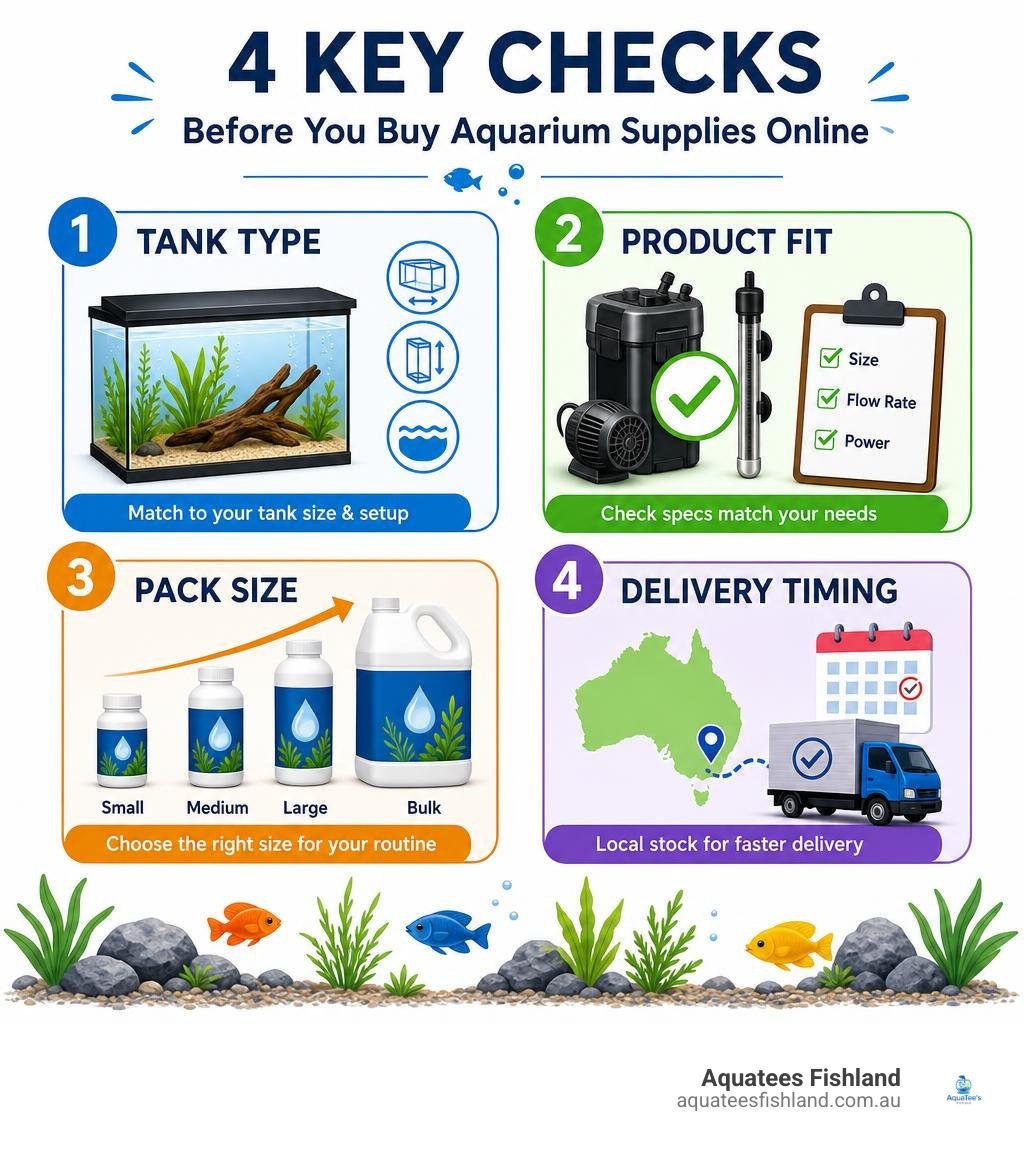
Before ordering aquarium supplies Australia customers commonly need, I recommend checking four things. First, choose items rated for your setup, whether that is a freshwater community tank, planted aquascape, or marine system. Then check equipment sizing, stock availability, useful pack sizes, and Australian dispatch details.
In my experience at Aquatees Fishland, choosing supplies by functional fit usually creates a more stable routine than choosing by price alone. It can also make regular tank maintenance easier to manage.
I'm Naim Ibn Nahshid, also known as Nemo Sulaiman. I'm part of the eCommerce and warehouse team at Aquatees Fishland, with two years of experience helping customers choose fish, equipment, and products. One thing I've learnt is that the right choice usually comes down to understanding your tank first.
What Aquarium Supplies Australia Shoppers Actually Need
When I help customers plan a first aquarium supplies Australia order, I group supplies into essential, recommended, and setup-dependent items. That keeps the decision practical. A small freshwater tank, planted aquascape, and marine system can need different combinations of equipment, water care, food, and maintenance tools.
| Supply Type | Priority | Why I Usually Check It |
|---|---|---|
| Fish tank or aquarium | Essential | The tank needs to suit the livestock, available space, and long-term setup rather than only the starting budget. |
| Filter | Essential | I check filtration against tank volume, livestock waste load, and the type of media the customer can maintain consistently. |
| Heater | Essential for many tropical setups | Heater need depends on species, room temperature, and seasonal changes, not tank volume alone. |
| Water conditioner | Essential | I usually recommend keeping this on hand for routine water changes and new water added to the aquarium. |
| Fish food | Essential | Food should suit the species, size, and feeding habits of the fish, shrimp, or other livestock in the tank. |
| Thermometer | Recommended | A thermometer makes it easier to check whether the room, heater, and seasonal conditions are keeping the tank in a suitable range. |
| Water test kit | Recommended | I suggest testing pH, ammonia, nitrite, and nitrate so problems can be spotted before they become harder to manage. |
| Filter media | Recommended | Filter media supports ongoing filtration and usually needs planned cleaning or replacement according to product directions. |
| Cleaning and maintenance equipment | Recommended | Gravel cleaners, algae pads, and aquarium-safe tools can make regular care easier without relying on improvised household items. |
| Nets and buckets | Recommended | Dedicated aquarium nets and buckets help with livestock handling, water changes, and keeping aquarium tools separate from household use. |
| Lighting | Setup-dependent | I check lighting more closely for planted tanks and display tanks, where intensity and timing matter more. |
| Substrate | Setup-dependent | Substrate can support plants, aquascaping, and natural behaviour, depending on the species and tank style. |
| Decorations or plants | Optional to recommended | Safe decorations and plants can provide cover and enrichment when they suit the livestock and do not create maintenance problems. |
| Air pump and air stone | Optional to recommended | These may help with surface movement and oxygen exchange, especially in warmer conditions or specific setups. |
For a simple freshwater community aquarium, I start with a suitable tank, filter, heater if needed, water conditioner, fish food, and basic maintenance tools. For planted, marine, reef, or heavily stocked tanks, I spend more time checking lighting, filtration capacity, test kits, substrate, and replenishment products. Those setups can be less forgiving.
Match Supplies to Your Livestock and Tank Type
Before buying aquarium supplies online, think about what is actually living in the tank. Goldfish, tropical community fish, bettas, cichlids, shrimp, marine fish, and planted aquariums can all have different care needs. The aim is not to buy every product available, but to choose supplies that match your species, water conditions, behaviour, and maintenance routine.
- Goldfish: I usually check filtration strength, tank space, and maintenance planning because goldfish can produce a heavy waste load.
- Tropical community fish: These setups generally need stable temperature, suitable food sizes, compatible filtration, and water care products matched to a mixed community tank.
- Bettas: I often look for gentle filtration, a suitable heater in many homes, covered tank space, and decorations or plants that do not damage delicate fins.
- Cichlids: These may need species-appropriate water parameters, robust filtration, suitable hiding places, and decor that suits their behaviour.
- Shrimp: I suggest extra care with water stability, so testing supplies, gentle filtration, and shrimp-safe treatments are worth checking closely.
- Marine fish: These setups usually need more specialised supplies, including appropriate filtration, saltwater testing, salinity monitoring, and careful replenishment planning.
- Planted tanks: I check lighting, substrate, filtration, fertiliser needs, and maintenance tools around both the plants and livestock.
One mistake I see beginners make is choosing supplies by product name alone. Checking livestock needs before ordering can help prevent mismatched purchases. Common examples include a filter with too much flow for a betta, food that is too large for small fish, or lighting that does not suit a planted aquarium.
What Water Care Products Do I Need?
For a typical freshwater aquarium, I recommend starting with a water conditioner, a water test kit, and only the setup-specific support products your tank genuinely needs. Not every aquarium needs every treatment product. It is usually better to build a small, practical water care kit around your livestock, water parameters, plants, and manufacturer directions.
A simple hierarchy can look like this:
- Water conditioner: Usually the first essential because it helps make tap water safer for aquarium use during water changes.
- Water test kit: Helps monitor pH, ammonia, nitrite, and nitrate so you can respond to water quality changes earlier.
- Beneficial bacteria product: May be useful when setting up a new aquarium, supporting a filter after maintenance, or following product directions for biological filtration support.
- Algae management products: Can be considered if algae becomes a recurring issue, but I would also check lighting, feeding, filtration, and maintenance routines.
- Fertiliser for planted tanks: Relevant for planted aquariums where plant growth, lighting, substrate, and livestock safety all need to be considered together.
Use treatments only when they match the problem you are trying to manage. Avoid mixing products unless the labels and manufacturer guidance support that use. If you are unsure, I would check the product directions, test the water first where appropriate, and choose the least complicated option that suits the aquarium.
Essential Equipment and Water Care Checklist
When preparing to buy fish supplies, I recommend confirming that each piece of equipment matches your tank setup before checking out.
- Filter Turnover Rates: When I'm helping someone choose a filter, I look for a unit that turns over the net tank volume around 4 to 6 times per hour, depending on livestock and setup. Browse our water filters collection to choose between internal, canister, or sponge filters suited to your bio-load.
- Heater Requirements: Not every aquarium needs a heater. Many tropical fish usually need stable warm water, while goldfish and other coldwater species often do not need heating unless the room becomes too cold for their species. In Australia, I suggest checking the room as well as the fish because heater need can vary by state, season, home insulation, tank position, and air conditioning.
- Heater Sizing: Tank volume is only the starting point. A common guide is about 1 watt per litre in standard home environments, or up to 1.5 watts per litre in cooler rooms, but the right size also depends on your target temperature, room temperature, lid coverage, water movement, and manufacturer recommendations. I use a thermometer to confirm the heater is maintaining the species-appropriate range rather than relying on wattage alone.
- Aquarium Temperature: Check the care requirements for your livestock before choosing a temperature. Tropical community fish are often kept in the mid-20s °C, while goldfish and many coldwater species generally prefer cooler water. I avoid giving one fixed temperature for every aquarium because suitable ranges can differ between species.
- Water Conditioners: Keep a quality tap water conditioner on hand for routine water changes. Follow bottle directions carefully to remove chlorine and chloramines, helping to protect nitrifying bacteria in your bio-media.
Ordering Aquarium Supplies Online in Australia
When buying aquarium supplies Australia customers need from an aquarium shop online Australia, I look at stock availability, pack sizes, and dispatch times. Those details can make online ordering smoother.
Larger pack sizes can suit high-use items like staple fish food, replacement filter pads, and water conditioners. They may reduce shipping frequency and help prevent sudden outages. For complete equipment setups, explore our aqua packs guide.
How to Buy Aquarium Supplies Online Safely
Buying aquarium supplies online can be safe and practical when you choose a clear Australian supplier, check product details carefully, and inspect your order when it arrives. In my experience, the most useful habit is to make sure the product suits your tank, appears genuine, arrives in usable condition, and fits your routine timeframe.
Before placing an online order, I suggest checking:
- Store information and product detail: Look for clear product names, sizes, photos, descriptions, usage directions, and support options.
- Product suitability: Match the product to your tank size, livestock, water type, and manufacturer recommendations rather than relying on the product name alone.
- Australian stock and delivery timing: Check stock status and dispatch information, especially for supplies you may need before the next water change or feeding cycle.
- Brand and packaging details: Genuine aquarium products should have recognisable branding, sealed packaging where relevant, readable labels, and clear dosage or usage instructions.
- Storage expectations: Many foods, conditioners, test reagents, and treatments should be stored according to label directions, away from heat, moisture, and direct sunlight where required.
- Arrival checks: When your order arrives, check seals, expiry or best-before dates where listed, bottle leaks, damaged packaging, correct sizes, and whether the product matches what you ordered.
I've found that some aquarium supplies can be stored for a while, but shelf life varies by product type and storage conditions. Food, test kits, liquids, and treatments may lose quality or accuracy over time. Avoid buying more than you can reasonably use within the labelled period.
Simple Water Care & Practical Dosing
At Aquatees Fishland, we stock products from our water conditioners collection that help make tap water safer for fish without confusing chemical calculations:
- Follow Label Directions: Calculate dosage based on new water added during regular changes, or total tank volume if treating directly.
- Protect Beneficial Bacteria: Regular water care may support a healthier biological filter without disrupting beneficial bacterial colonies.
- Maintain Aeration in Heat: During hot Australian summers, warmer water holds less dissolved oxygen. I usually suggest checking air pumps or surface agitation when adding any water treatments.
Essential Answers for Ordering Fish Tank Supplies in Australia
What should I check before buying aquarium supplies online?
Before completing an online order for aquarium supplies Australia shoppers usually need, I recommend checking four main factors: equipment compatibility, Australian stock, pack sizes, and supplier support. Check dimensions, flow rates, and power consumption against your tank's specifications. Also confirm the store holds local stock, offers practical pack sizes, and can answer setup or compatibility questions before you buy.
How do I plan ongoing replenishment and choose container sizes?
Planning replenishment around your water change schedule can reduce the risk of unexpected shortages of essentials like water conditioners, test reagents, and fish food. I usually suggest buying standard items in bulk only when you use them regularly and can store them correctly. Delivery time should also shape when you reorder.
For example, Aquatees Fishland currently lists FritzZyme 7 in 236 ml, 473 ml, 946 ml, and 3.7 L options. That gives aquarists with small desktop nano tanks or larger multi-tank setups a way to choose a practical quantity. You can browse our full range through our fish supplies store guide.
How do I safely test water and use water care treatments?
Follow manufacturer label instructions when testing tank water and dosing treatments. When I help customers with water care basics, I recommend tracking pH, ammonia, nitrite, and nitrate regularly, especially when adding new livestock or changing filter media. Explore our water tests and treatments category to find test strips and master test kits suited to beginner and experienced fishkeepers.
Aquarium Supplies Australia: Key Buying Takeaways
Choosing the right aquarium supplies in Australia is more straightforward when you focus on practical compatibility, accurate tank volume, reliable local stock, and the actual livestock in your aquarium. From helping customers at Aquatees Fishland, I've found that the best starting point is simple. Check product specifications, plan replenishment for essentials like water care and food, and order from a supplier that makes it easier to match supplies to your setup.
For your next aquarium supplies Australia order, start with the product categories most relevant to this guide:
- Browse water filters for filtration options suited to your aquarium size and bio-load.
- Check water conditioners for routine tap water treatment during water changes.
- Compare water tests and treatments to monitor water quality and manage common care tasks.