

How Often Should You Clean a Fish Tank?
Knowing how often to clean a fish tank is one of the most important things you can do for your fish's health. Here is a quick reference before we dive into the detail:
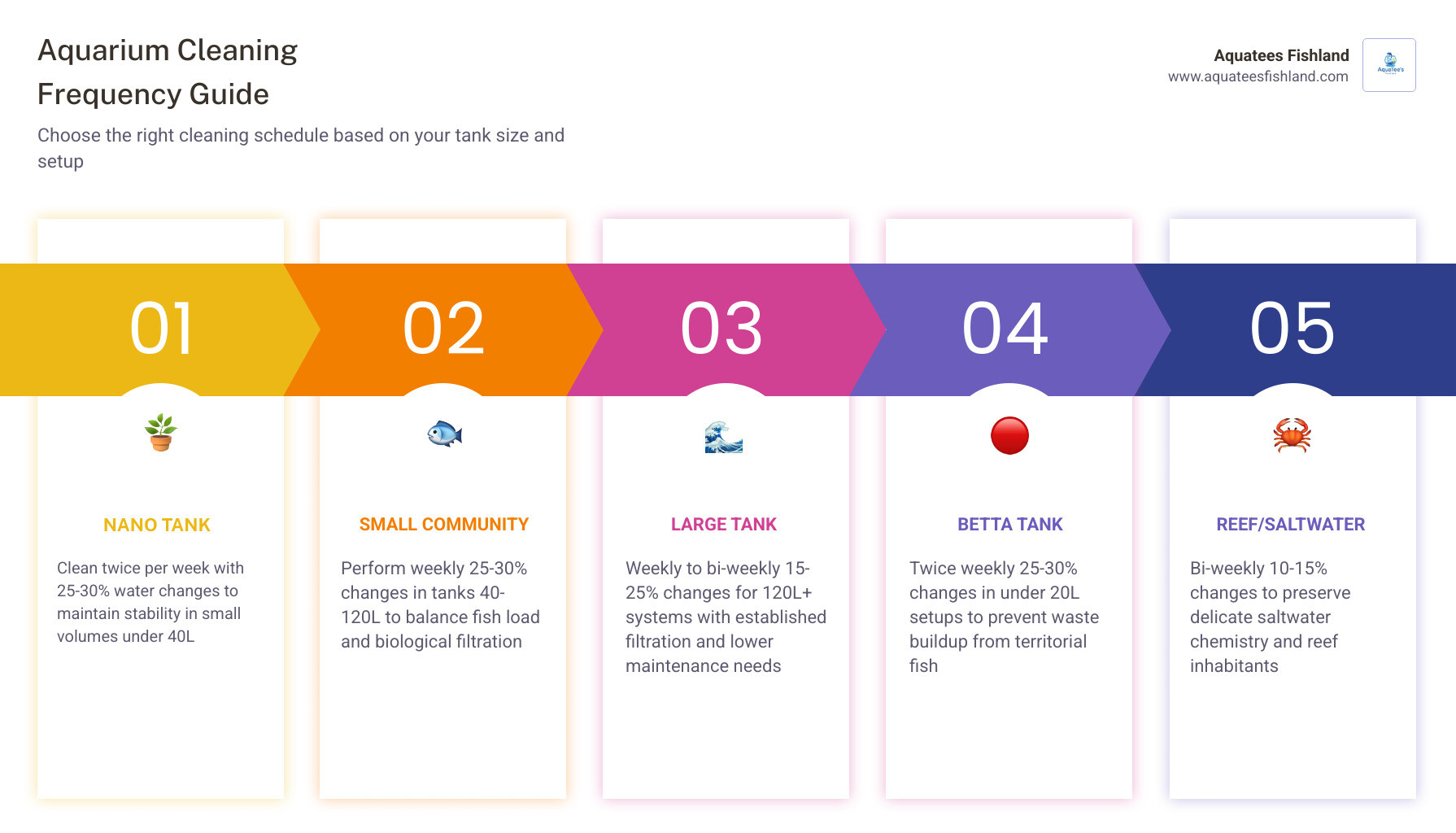
| Tank Type | Water Change Frequency | Amount to Change |
|---|---|---|
| Nano tank (under 40L) | Twice per week | 25-30% |
| Small community tank (40-120L) | Weekly | 25-30% |
| Large established tank (120L+) | Weekly to bi-weekly | 15-25% |
| Betta tank (under 20L) | Twice per week | 25-30% |
| Reef / saltwater tank | Every two weeks | 10-15% |
On top of water changes, most tanks benefit from a more thorough clean once a month, which includes vacuuming the substrate, wiping the glass, and rinsing filter media in old tank water.
Your aquarium is a living ecosystem, and the honest answer is that cleaning frequency depends on your tank size, how many fish you keep, what you feed them, and how well your filtration is set up. A heavily stocked 40L tank will need far more attention than a lightly stocked 200L with a quality canister filter running.
What trips most people up is thinking their tank is fine because the water looks clear. Dissolved waste like ammonia, nitrites, and nitrates are completely invisible, and by the time things look bad, your fish are already under stress.
My name is Nemo Sulaiman, and working at Aquatees Fishland across eCommerce, warehousing, and daily customer support has given me a front-row seat to what actually goes wrong when people skip or rush their cleaning routines. Everything I share about how often to clean your fish tank comes from real situations, real tanks, and real problems I have helped customers work through.
Understanding the Biological Filter in Your Aquarium
Mini definition box: A biological filter is a collection of beneficial bacteria that live on surfaces within your tank, primarily responsible for converting toxic fish waste (ammonia) into less harmful substances (nitrates) through the nitrogen cycle.
To understand how often to clean fish tank setups, you first need to understand what is happening behind the scenes. Your aquarium is not just a glass box of water; it is a biological processing plant. Every time you feed your fish, they produce waste. This waste, along with uneaten food and decaying plant matter, breaks down into ammonia.
Ammonia is incredibly toxic to fish. Even small amounts can burn their gills and lead to a quick death. This is where the nitrogen cycle comes in. In a healthy, cycled tank, beneficial bacteria live on your filter media, aquarium sand and soil, and decorations. These bacteria eat the ammonia and turn it into nitrite. Nitrite is also very toxic, so a second group of bacteria then converts that nitrite into nitrate.
Nitrate is much less harmful, but it still builds up over time. While live plants will eat some of it, the only way to truly remove it in most home setups is through regular water changes. This is why the Guide to Fish Tank Size matters so much; a larger volume of water dilutes these toxins, giving you a bigger safety net. Keeping your nitrate levels below 40 ppm is essential for a stress-free environment.
How biological filtration works
The process of moving from ammonia to nitrate is called nitrification. It relies on two main types of bacteria: Nitrosomonas, which handle the ammonia, and Nitrobacter, which finish the job by converting nitrite. These little guys are living creatures, and they need oxygen and food to survive.
When you start a new tank, these bacteria are not present in high enough numbers to keep your fish safe. This is known as "New Tank Syndrome." To avoid this, we recommend biofilter seeding. Using a product like FritzZyme 7 Freshwater Bacteria introduces millions of live, nitrifying bacteria into your system immediately. Unlike some "bacteria in a bottle" products that use land-based spores, FritzZyme 7 contains the actual species found in freshwater environments, which can help your tank cycle in days rather than weeks.
Common Biological Media Types and Their Role

The bacteria that keep your water safe need a place to live. They prefer surfaces that have a lot of tiny nooks and crannies. This is why we use specific types of filter media. Think of your filter media as a high-density apartment complex for your beneficial bacteria.
- Sponges: These provide excellent surface area and act as both mechanical and biological filtration. The Aquatees 3-in-1 Bio Filter Sponge is a great example, offering different densities to trap waste while giving bacteria a home.
- Ceramic Rings and Stones: These are highly porous. They might look solid, but they are filled with microscopic holes that allow water to flow through and bacteria to colonise.
- Filter Wool: Products like Dymax White Wool Sponge are primarily for mechanical filtration (trapping the "gunk"), but they will also host bacteria over time.
The goal is to provide as much surface area as possible. The more surface area you have, the more bacteria you can support, and the more waste they can process. This directly impacts how often to clean fish tank filters; if your media is clogged with physical waste, the water can't reach the bacteria, and your biological filter will struggle.
Choosing the right substrate for bacteria
Your substrate (the stuff on the bottom) is more than just decoration. It is actually one of the largest biological filters in your tank. If you use a porous gravel or specialized media, you are significantly increasing your tank's stability.
For those who like a bit of colour, Dymax Green Gravel provides a safe, non-toxic base for your fish. However, for serious biological capacity, many hobbyists add Seachem Matrix to their filters. Matrix is a high-porosity solid designed to provide over 700 square metres of surface area per litre. It is so effective that it can even support anaerobic bacteria deep inside its pores, which can help reduce nitrates naturally.
How Often to Clean Fish Tank for a Healthy Ecosystem

There is no single rule for how often to clean fish tank water because every tank is different. However, we can look at several factors to build a schedule that works for you. The main things to consider are your tank volume, your fish load (how many fish and how big they are), and your filtration capacity.
If you have a 40L tank with four or five fish, you are going to see waste build up much faster than in a 200L tank with the same number of fish. Most established freshwater tanks thrive with a 10% weekly water change or a 25% change every two weeks. If you are just starting out, checking our Best Fish Tanks for Beginners guide can help you pick a size that is easier to maintain.
Determining how often to clean fish tank based on volume
Smaller tanks are actually harder to keep clean than larger ones. In a small volume of water, a single dead leaf or a bit of extra fish food can cause a massive ammonia spike. Larger tanks have more "buffer" room.
| Tank Size | Recommended Cleaning Frequency |
|---|---|
| Nano (<40L) | 25-30% water change twice per week |
| Medium (40-120L) | 25-30% water change once per week |
| Large (120L+) | 20-25% water change every 1-2 weeks |
For most community tanks, a weekly 25-30% water change is the "sweet spot." This keeps the water fresh, replenishes minerals, and keeps nitrates low without shocking the fish. If you have "messy" fish like Goldfish or Oscars, you might need to bump that up to 40-50% weekly.
Signs your aquarium needs immediate attention
Sometimes you can't wait for your scheduled cleaning day. You need to "listen" to your tank. If you notice any of the following, it is time for an immediate water change and a check of your parameters:
- Cloudy Water: This could be a bacterial bloom or a sign of excess waste.
- Foul Odour: A healthy tank should have a faint, earthy smell. If it smells like rotten eggs or "fishy," something is wrong.
- Algae Buildup: Rapid algae growth usually means you have too many nitrates or phosphates in the water.
- Fish Gasping: If your fish are at the surface gulping air, it often means ammonia or nitrites have damaged their gills or the oxygen levels are too low.
If your water is looking a bit hazy but your parameters are okay, a product like Fritz Crystal Clear can help. It works by "clumping" fine particles together so your filter can easily trap them. It is a great way to get that polished, crystal-clear look between deep cleans.
Best Practices for Maintenance and Preserving Bacteria
The biggest mistake beginners make is being "too clean." If you take your filter media to the kitchen sink and scrub it with tap water, you will kill almost all your beneficial bacteria. Tap water contains chlorine and chloramines specifically designed to kill bacteria. In your tank, those bacteria are your best friends.
When you are performing your maintenance, always rinse your filter sponges and media in the bucket of old tank water you just siphoned out. This removes the physical gunk but keeps the bacteria alive. Also, never change all your filter media at once. If your sponge is falling apart, replace half of it, wait two weeks for the new half to be colonised, and then replace the other half.
Substrate vacuuming is another essential task. Use a gravel vacuum to "churn" the top layer of your gravel. This pulls out the fish waste (detritus) that has settled there. However, don't try to clean every single centimetre of the gravel in one go. Focus on about one-third of the tank each time to ensure you don't disturb too much of the bacterial colony at once.
After the clean, you need to add fresh water. This water must be temperature-matched (within a degree or two) to your tank water to avoid shocking your fish. You must also use a water conditioner. To help the tank recover from the cleaning process, adding Seachem Stability is a smart move. It adds a blend of aerobic and anaerobic bacteria that helps reinforce your biofilter after you have poked and prodded it.
Essential tools for effective cleaning
Having the right tools makes the job faster and less messy. If cleaning is easy, you are more likely to do it!
- Gravel Vacuum: This is the most important tool for removing waste from the bottom of the tank.
- Algae Scraper: A magnetic cleaner or a simple scraper helps keep the glass clear so you can actually see your fish.
- Dedicated Bucket: Never use a bucket that has held household cleaners or soap. Even a tiny residue of soap can be fatal to fish.
- Water Conditioner: Seachem Prime is the industry standard for a reason. It removes chlorine and chloramine and also detoxifies ammonia and nitrite for up to 48 hours, which is a lifesaver if you have a mini-cycle after cleaning.
- Quality Filtration: If you find yourself cleaning too often, your filter might be too small. Upgrading to something like Periha UV Canister Filters provides massive biological capacity and built-in UV sterilisation to keep water clear and pathogens low.

Frequently Asked Questions about Aquarium Cleaning
How often to clean fish tank with a Betta?
Betta fish are territorial and thrive best when kept alone in tanks of at least 10 gallons (38 litres). For a filtered 10-gallon Betta tank, you should perform a 25% water change once a week, ensuring you use a gentle siphon to avoid stressing the fish. If you keep tankmates like shrimp or snails, monitor the waste levels closely as these add to the biological load.
Small Betta tanks under 20 litres often require 25-30% water changes twice per week because the biological cycle is less stable in tiny volumes.
Should I remove my fish during cleaning?
No, you should generally leave your fish in the tank during routine maintenance and water changes.
Catching fish with a net causes significant stress and can damage their protective slime coat, whereas they will simply swim to the other side of the tank while you vacuum the gravel.
The only exception is if you need to do a complete teardown due to a major disease outbreak or if you are moving the tank. For regular weekly cleans, keeping them inside is much safer.
How often to clean fish tank filters?
Filter media should be rinsed in old aquarium water approximately once a month or when you notice the flow rate from the filter outlet has slowed down.
Never use tap water to clean your biological media, as the chlorine will kill the beneficial bacteria that keep your water safe. Mechanical media, like filter floss or white wool, can be replaced more frequently (weekly or bi-weekly) if it becomes heavily clogged, as its main job is just to trap particles.
Simple Habits for a Thriving Aquarium
Consistency is what keeps an aquarium stable, clear, and safe for your fish. When you follow a simple cleaning routine and use reliable products from brands like Seachem, Fritz, and Hikari, you can avoid many common tank problems before they begin. The golden rule is simple: keep the water clean, but protect the beneficial bacteria living in your filter.
All products at Aquatees Fishland are thoroughly quality checked and inspected before packing to ensure you receive only the best for your aquatic pets.
We take great care in our secure packaging so your items arrive safely at your door in Melbourne or anywhere across Australia. We are committed to providing Australian hobbyists with expert advice and premium supplies at warehouse prices. Happy fishkeeping!
Explore our range