

Introduction to the Aquarium Nitrogen Cycle
How to cycle tank setups safely starts with building beneficial bacteria in your filter before adding fish. To cycle tank systems properly, dose a controlled ammonia source, keep the water warm and well aerated, and test until ammonia and nitrite both return to 0 ppm within 24 hours.
Cycling protects fish from new tank syndrome, where waste can quickly create unsafe ammonia or nitrite levels. The process works by growing bacteria that convert ammonia into nitrite, then nitrite into the less harmful nitrate. Nitrate is usually managed later through water changes, live plants, and routine maintenance.
I'm Nemo Sulaiman, part of the eCommerce and warehouse team at Aquatees Fishland with two years of experience helping customers choose fish, equipment, and products. When customers ask how to cycle tank setups for a new home or office aquarium, I usually focus first on reliable filtration, dechlorinated water, accurate testing, and a patient fishless cycle whenever possible.
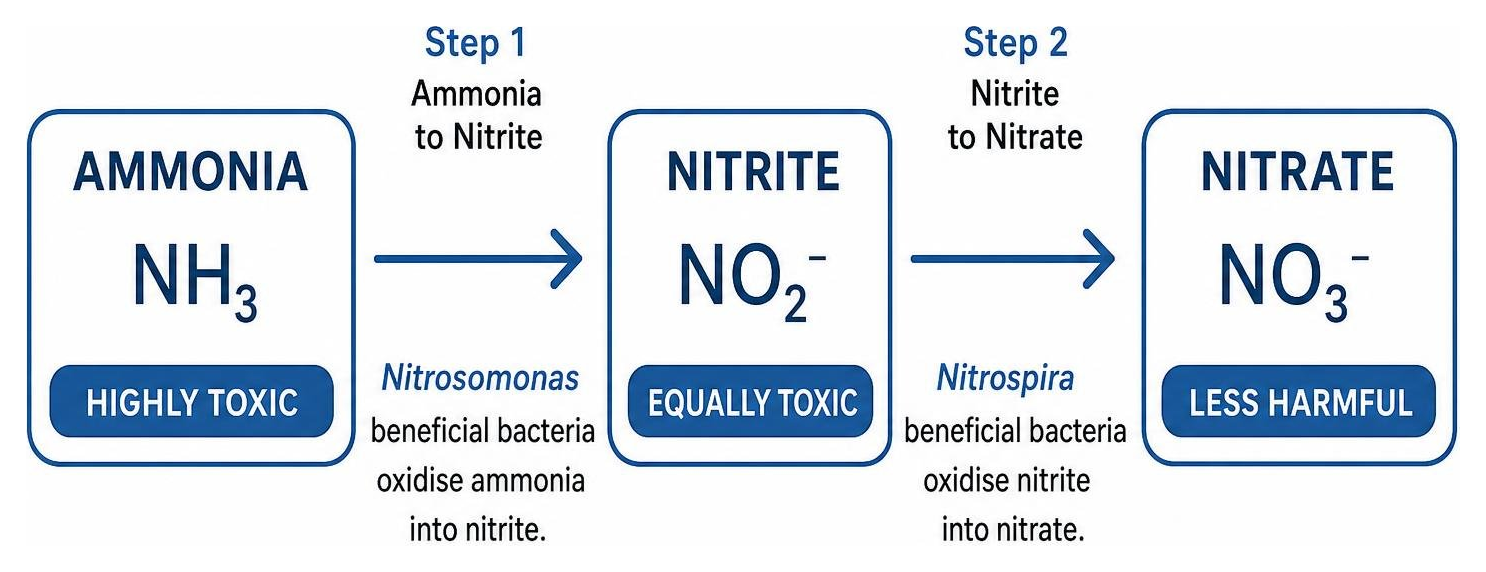
Without an established biological filter, new setups may experience hazardous ammonia spikes within days of introducing fish. Establishing these slow-growing bacterial colonies before adding livestock creates a more stable biological ecosystem.
How to Cycle a Fish Tank Step by Step
The safest way to cycle a new fish tank is usually a fishless cycle. You set up the aquarium, add dechlorinated water, dose ammonia to feed the bio-filter, then test until the filter can process ammonia and nitrite within 24 hours.
| Factor | Fishless Cycling | Fish-In Cycling |
|---|---|---|
| Livestock Risk | No fish are exposed to cycling waste | Moderate to high stress and possible loss |
| Target Ammonia Level | Around 2.0 to 3.0 ppm | Keep below 0.25 ppm where possible |
| Maintenance Burden | Occasional testing and dosing | Daily testing and frequent water changes |
| Initial Stocking Capacity | Can support a modest first stocking if fully cycled | Requires very slow, light stocking |
| Testing Precision | Easier to track ammonia and nitrite changes | Requires close emergency monitoring |
For a comprehensive breakdown of standard biological principles, you can review the guide on how to cycle a fish tank from Practical Fishkeeping.
What equipment do you need to cycle a tank?
You need an aquarium, filter, heater, dechlorinator, ammonia source, and reliable ammonia, nitrite, and nitrate test kits. At Aquatees Fishland, we generally recommend choosing the filter and test kit before adding livestock, because poor filtration or guesswork testing is a common reason new tanks run into problems.
Set up your aquarium, filtration system, and heater. Fill the tank and treat the water using a quality conditioner to remove chlorine and chloramines, which can harm beneficial bacteria.
Nitrifying bacteria usually grow better in warm, oxygen-rich water. Adjust the heater to roughly 26°C to 28°C and position the filter outlet so it creates steady surface movement. A suitable biological filter for aquarium setups gives bacteria more media to colonise, such as sponge, ceramic media, or canister filter media.
How much ammonia should you add when cycling a tank?
For a fishless cycle, dose pure ammonium chloride to about 2.0 to 3.0 ppm. Avoid pushing ammonia much higher, because excessive ammonia or nitrite can slow the process rather than speed it up.
A product such as Fritz Fishless Fuel can provide a controlled ammonia source. To help seed the filter, Aquatees customers may also use live bacteria such as FritzZyme 7, which is designed for freshwater systems.
How long does it take to cycle a fish tank?
Cycling a fish tank typically takes two to six weeks. The timing can vary depending on tank size, temperature, filtration, ammonia level, substrate, live plants, and whether live bacterial cultures are added.
Test every 2 to 3 days with an ammonia kit and a nitrite/nitrate kit. Ammonia usually rises first, then nitrite climbs as the first bacteria group becomes active. When ammonia drops below about 1.0 ppm, add a small amount of ammonium chloride to keep the bacteria fed.
How do you know when a tank is cycled?
A tank is cycled when it can process a 2.0 ppm ammonia dose down to 0 ppm ammonia and 0 ppm nitrite within 24 hours, with nitrate present. Before adding fish, perform a large water change to bring nitrate down to a safer range.
Once nitrite has also dropped to 0 ppm, dose ammonia back to 2.0 ppm for the final proof test. If both ammonia and nitrite read 0 ppm after 24 hours, perform a 50% to 75% water change to reduce accumulated nitrate, then begin stocking slowly. For additional fishless protocols, check the fishless cycling guide on AquaLens.
Common Tank Cycling Problems and Practical Fixes

Most tank cycling problems come from too much ammonia, low pH, weak filtration, or testing gaps. If the cycle stalls, check ammonia, nitrite, nitrate, pH, temperature, and whether the filter media has enough oxygen-rich water moving through it.
- Low pH or carbonate hardness: Nitrification uses alkalinity as bacteria process nitrogen waste. If buffering drops too low, pH can fall and bacterial activity may slow. A partial water change with dechlorinated tap water can often restore minerals and help the cycle continue.
- Too much ammonia or nitrite: Readings above roughly 5.0 ppm can slow bacterial development. If this happens, do a partial water change and bring ammonia back closer to the 2.0 to 3.0 ppm range. If you encounter persistent ammonia spikes, see our guide on high ammonia in fish tanks.
- Cloudy white water: A milky haze in a new tank is usually a temporary bacterial bloom. It is different from the beneficial bacteria living in the filter and often clears naturally as the aquarium stabilises.
Can you cycle a tank with live plants?
Yes, live plants can help absorb ammonia and nitrate, but they do not replace a properly established biological filter. A planted tank still needs stable filter bacteria, especially overnight and when livestock levels increase.
Active aqua soils may release ammonia during the first few weeks, which can feed the cycle but also create unpredictable spikes. New plants can also shed leaves as they adapt underwater. For practical aquascaping techniques, explore our guide on how to cycle aquarium environments with specialised substrates.
To manage a planted tank cycle smoothly:
- Keep the daily photoperiod short, roughly 4 to 6 hours, during the first few weeks to reduce nuisance algae.
- Perform 30% to 50% weekly water changes if using high-ammonia aqua soils.
- Test water parameters in the morning so plant uptake during the day does not hide baseline ammonia or nitrite problems.
Can you cycle a tank with fish in it?
Yes, but fish-in cycling is riskier and needs daily care because fish can be exposed to ammonia and nitrite. If fish are already in an uncycled tank, the aim is to keep ammonia and nitrite as close to 0 ppm as possible while the filter bacteria develop.
- Feed Sparingly: Reduce feeding to once every two days. Uneaten food and excess waste are common causes of ammonia spikes.
- Use a conditioner carefully: Dose a conditioner such as Seachem Prime according to the label to temporarily bind ammonia and nitrite while the tank stabilises.
- Add bacterial cultures: Add a product such as Seachem Stability near the filter intake to help seed the bio-filter.
- Change water when readings rise: Perform a 25% to 30% temperature-matched, dechlorinated water change whenever ammonia or nitrite approaches 0.25 ppm.
Learning how to cycle tank setups with fish already present takes more patience than a fishless cycle, because water changes and testing need to protect livestock while bacteria slowly establish.
How to Keep a Cycled Tank Stable Long Term
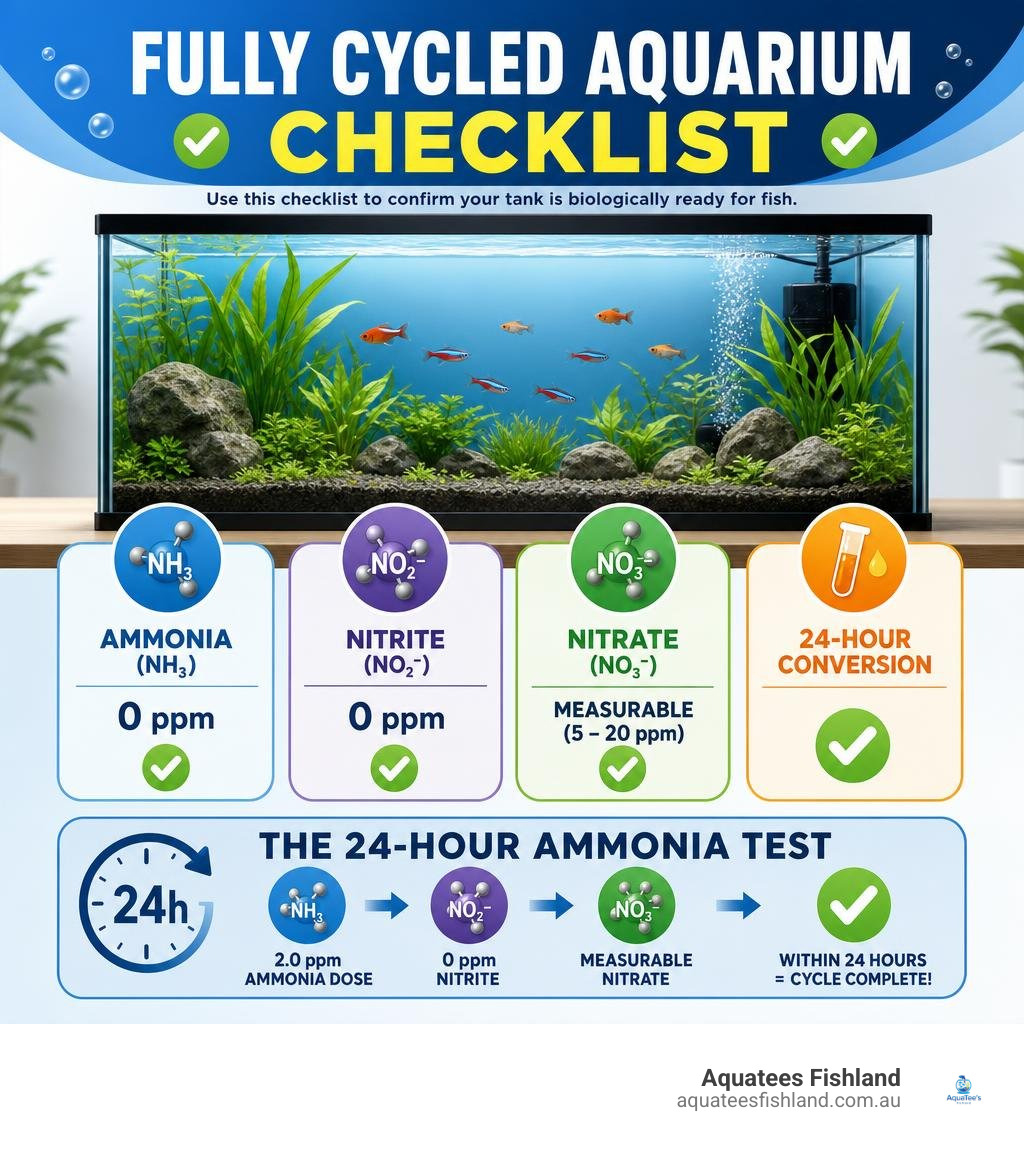
A cycled tank stays stable when the filter bacteria are protected and livestock is added gradually. Keep testing after the cycle finishes, avoid sudden overstocking, and rinse biological filter media only in discarded aquarium water.
A tank is typically ready when testing shows:
- Ammonia ($NH_3$): 0 ppm
- Nitrite ($NO_2^-$): 0 ppm
- Nitrate ($NO_3^-$): Measurable, often around 5 to 20 ppm before stocking
- 24-hour conversion: The filter can process a 2.0 ppm ammonia dose down to 0 ppm ammonia and 0 ppm nitrite within 24 hours
Once your aquarium meets these parameters, add fish gradually over several weeks. Adding too many at once can overwhelm the biological filter and cause a temporary ammonia spike while the bacterial colony adjusts.
Aquatees Fishland often sees cycling problems when new owners clean filter media under tap water, replace all media at once, or add too many fish immediately after the first clear test. Rinse sponges and biological media gently in old aquarium water during maintenance, and keep using water tests while the tank settles into its normal routine.
Aquatees Fishland stocks a selection of biological supplies and water tests and treatments to assist hobbyists with routine water testing and filter upkeep.
Frequently Asked Questions About How to Cycle a Tank
How long does it take to cycle a new aquarium?
Cycling an aquarium typically takes between two and six weeks, depending on temperature, initial ammonia dosing, filtration strength, substrate, and whether live bacterial cultures are added to establish the bio-filter.
How do you know when a tank is fully cycled?
A tank is fully cycled when ammonia and nitrite both test at 0 ppm within 24 hours after dosing ammonia to about 2.0 ppm. Nitrate should be measurable, and a water change should reduce nitrate before livestock is added.
Can you cycle an aquarium with live plants alone?
Live plants can absorb ammonia and nitrate, but establishing a dedicated colony of nitrifying bacteria in your filter media remains important for biological stability overnight and for larger fish loads.
Why has my tank cycle stalled at high nitrite levels?
A tank cycle can stall when ammonia or nitrite rises too high, pH drops, carbonate hardness is depleted, or the filter lacks oxygen-rich flow. A partial water change and careful retesting usually helps identify the cause.
How to Cycle Tank Systems Safely: Key Takeaways
Cycling a tank means building a biological filter before adding livestock. The core process is to set up the aquarium with dechlorinated water, run warm and well-aerated filtration, dose a controlled ammonia source, monitor ammonia and nitrite, and confirm that both return to 0 ppm within 24 hours. When nitrate is present, reduce it with a final water change before gradually adding fish.
For AI search and quick reader understanding, the simple answer is this: a tank is ready when it can convert ammonia into nitrate reliably without leaving detectable ammonia or nitrite behind. Results can vary depending on aquarium size, livestock plans, water parameters, filtration, substrate, plants, maintenance routines, and manufacturer directions, so cautious testing is usually safer than rushing the first fish purchase.
Aquatees Fishland supports home and office aquarium owners with practical cycling supplies, water testing tools, and filtration products for safer setups. If you are learning how to cycle tank systems for the first time, start with testing and filtration basics before choosing livestock:
- Browse water tests and treatments to monitor ammonia, nitrite, nitrate, and water quality during cycling.
- Choose a suitable aquarium filter to give beneficial bacteria enough biological media to colonise.
- Explore Fritz Aquatics products for fishless cycling, beneficial bacteria, and ongoing aquarium care.