

Why Fish Aquarium Filters Are the Foundation of a Healthy Tank
Choosing fish aquarium filters is an important decision for a hobbyist. Without proper filtration, waste builds up fast, water turns toxic, and fish become stressed before you even realise something is wrong.
An aquarium filter acts like the kidneys of your tank, constantly cleaning the water to keep the entire system alive and stable.
This process prevents the accumulation of harmful compounds that are invisible to the naked eye.
| Filter Type | Best For | Tank Size |
|---|---|---|
| Sponge Filter | Nano tanks, fry, low bioload | Under 40L |
| Internal Filter | Beginners, small to medium setups | 30-200L |
| Hang-On-Back (Power) Filter | Mid-size community tanks | 40-200L |
| External Canister Filter | Larger tanks, planted tanks, heavy bioload | 100L+ |
A filter does three things at once: it removes physical waste, supports the beneficial bacteria that break down ammonia, and helps keep the water moving and oxygenated.
That combination is what keeps a tank stable between water changes, not just clear-looking.
The type of filter you choose will depend on your tank size, how many fish you are keeping, and how much maintenance you are willing to do.
There is no single best option, but there is a right fit for your setup.
I am Naim Ibn Nahshid, part of the team at Aquatees Fishland, and after handling a range of fish aquarium filters across different setups, I have seen how different filters perform.
Let us break it all down so you can select a filter with confidence.
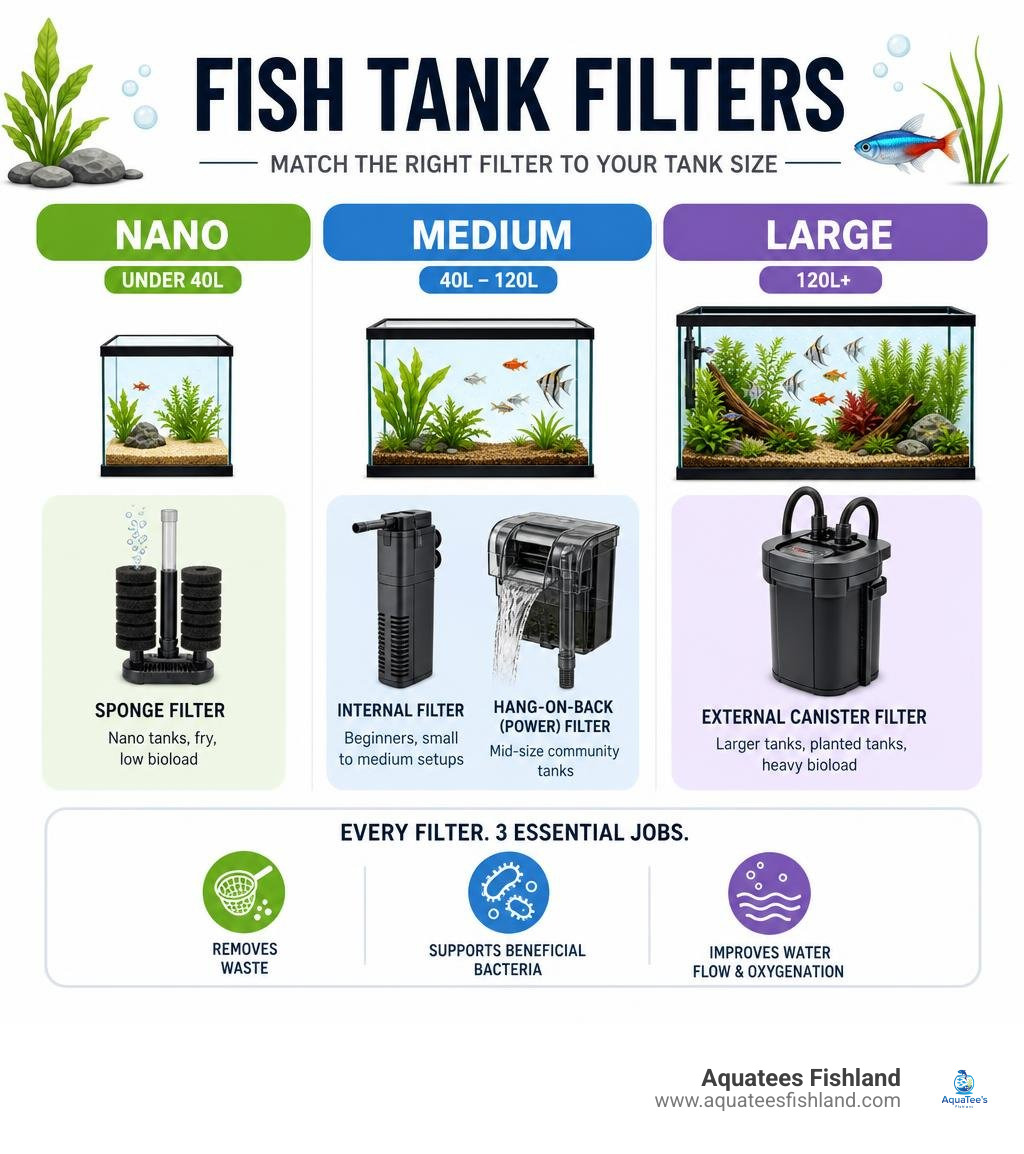
The infographic above compares filter types for nano setups under 40 litres, medium setups from 40 to 120 litres, and large setups over 120 litres.
Matching your filter to your specific tank volume ensures that the water is cycled efficiently.
Smaller tanks require gentle flow to protect delicate inhabitants, while larger systems need robust turnover to handle higher waste levels.
How to Choose the Best Fish Aquarium Filters
Choosing the best fish aquarium filter depends on matching the filtration unit to your tank's volume, the specific bioload of your livestock, and the required water turnover rate. We generally recommend selecting a filter that can cycle your entire tank volume at least four to six times per hour.

When you are browsing through options, it is easy to get overwhelmed by the sheer volume of choices.
To make the right decision, you need to look closely at your livestock.
If you are planning to keep messy eaters like goldfish or large cichlids, you will need a heavy-duty system with plenty of space for custom media.
On the other hand, a lightly stocked planted tank with neon tetras will have much lower filtration demands.
Water circulation is another major factor.
Good flow ensures that nutrients and dissolved oxygen are distributed evenly to every corner of your tank, which prevents stagnant dead spots where debris can accumulate.
For those setting up a new system or upgrading an old one, taking the time to explore Aquatees Fishland Water Filters is a practical way to ensure your aquatic environment remains clean, balanced, and thriving.
Comparing Different Types of Fish Aquarium Filters
External canister filters offer high performance and media capacity for larger setups, while internal and power filters provide compact, cost-effective options for small to medium tanks. Sponge filters remain a gentle choice for fry, shrimp, and nano tanks.
To help you understand your choices, we have put together a detailed comparison of the most popular configurations used by Australian hobbyists.
If you want to dive deeper into specific setups, you can read more on the Aquatees Fishland Blog.
- Sponge Filters: These operate using an air pump to draw water through a porous sponge. They are safe for baby fish and shrimp, making them a staple in breeding setups. To learn more about how they operate, check out our guide on the different Types Of Sponge Filters. For larger setups, the Aquatees Jumbo Sponge is an option for biological filtration.
- Internal Filters: Positioned entirely inside the tank, these are compact and easy to install. They are suitable for small to medium tanks but do take up swimming space. You can read our detailed breakdown of the Internal Tank Filter to see if this style suits your layout.
- Hang-On-Back (Power) Filters: These hang on the back glass of your aquarium, drawing water up through an intake tube and returning it via a gentle waterfall. They are easy to maintain and do not take up space inside the tank, making them a common Best Tank Filter option for beginners.
- External Canister Filters: Sitting underneath the tank in your cabinet, canister filters are the heavy lifters of the aquarium world. They offer large media capacity and water flow. Units like the Periha EC Canister include built-in UV sterilizers to help keep water clear. Learn more about how they work in our article on the External Filter Pump.
Let us look at how these different filter types compare across key performance metrics.
The table below outlines mechanical filtration, biological capacity, maintenance frequency, and noise levels for each style.
| Filter Type | Mechanical Filtration | Biological Capacity | Maintenance Frequency | Noise Level |
|---|---|---|---|---|
| Sponge Filter | Moderate | Excellent | Low (squeeze in tank water) | Low to Medium (bubbling) |
| Internal Filter | High | Moderate | High (weekly or fortnightly) | Very Low |
| Hang-On-Back | High | Moderate | Medium (fortnightly) | Low (water splash) |
| Canister Filter | Very High | Outstanding | Low (every 1 to 3 months) | Extremely Low |
Top Picks for Beginners and General Hobbyists
If you want a simple shortlist instead of comparing every filter style, these three options cover the most common aquarium setups: medium to large display tanks, everyday home aquariums, and specialist tanks for shrimp, fry, or quarantine use.
1. Periha EA External Canister Filter — Best Overall Canister Filter for Freshwater Aquariums
The Periha EA External Canister Filter is an excellent all-round choice for medium to large aquariums. Its large media capacity supports effective mechanical and biological filtration, while the external design keeps equipment out of the display tank.
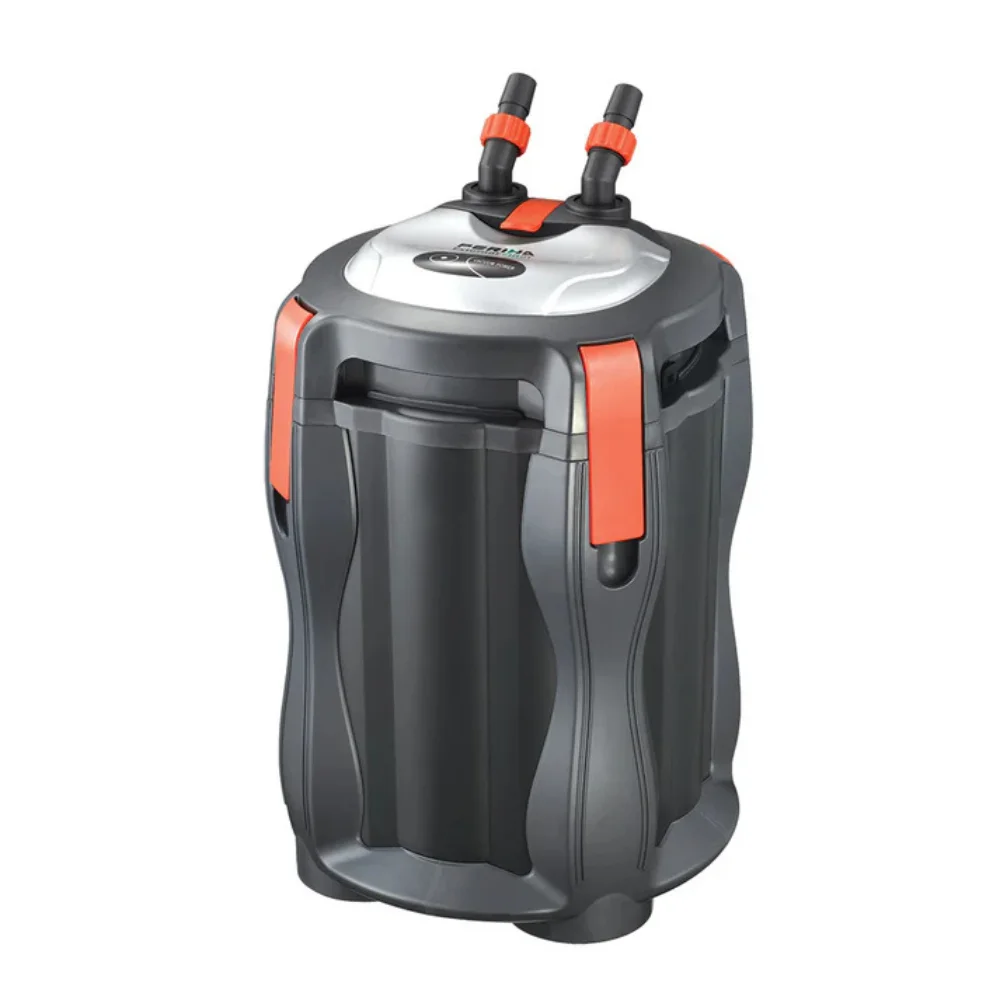
It is well suited to community aquariums, planted tanks, and aquariums with higher stocking levels where steady circulation and flexible media space are important.
2. Seachem Tidal Power Filter 55 — Best Hang-On-Back Filter for Small to Medium Aquariums
The Seachem Tidal Power Filter 55 is a premium hang-on-back filter that is easy to install and maintain. It features a large media basket for customised filtration, a built-in surface skimmer to remove surface film, and a self-priming design that automatically restarts after power interruptions.
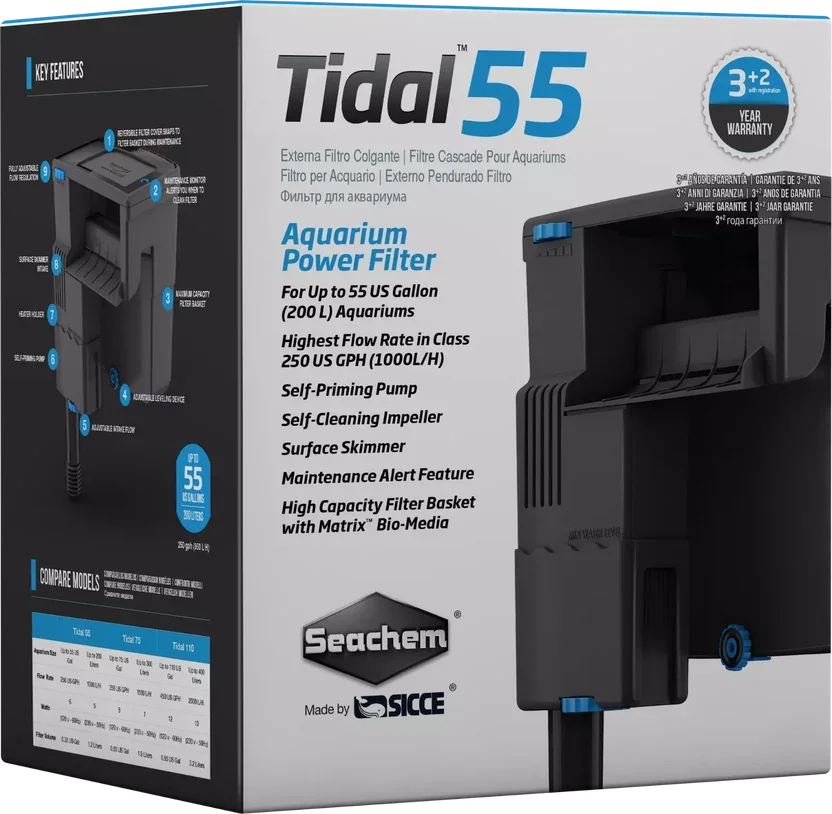
It is a strong option for beginner and intermediate fishkeepers who want reliable everyday filtration without moving up to an external canister.
3. Aquatees Jumbo Bio Sponge Filter XY-Series — Best Sponge Filter for Shrimp, Fry, and Quarantine Tanks
The Aquatees Jumbo Bio Sponge Filter XY-Series provides gentle biological filtration while also improving aeration when connected to an air pump. It is ideal for shrimp tanks, breeding aquariums, fry grow-out tanks, and hospital or quarantine setups where delicate livestock benefit from low water flow.
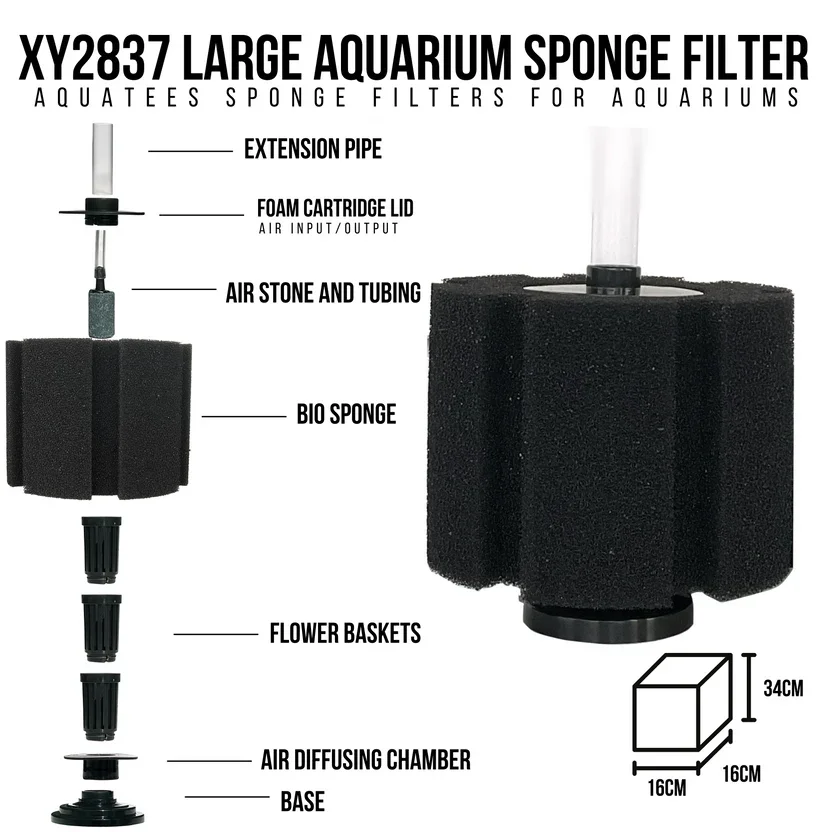
In short, choose the Periha EA External Canister Filter for medium to large display tanks, the Seachem Tidal Power Filter 55 for everyday home aquariums, and the Aquatees Jumbo Bio Sponge Filter XY-Series for breeding, shrimp, and specialised tanks.
The Role of Mechanical, Biological, and Chemical Filtration
Effective aquarium filtration relies on three distinct stages: mechanical filtration to trap physical debris, biological filtration to neutralise toxic chemical waste, and chemical filtration to remove dissolved impurities and odours.
Think of mechanical filtration as a simple kitchen sieve that catches large food particles before they can dissolve.
Biological filtration is like a natural waste treatment plant, where tiny workers break down invisible toxins.
Chemical filtration acts like a sponge soaking up invisible spills, removing discolouration and smells from the water column.
- Mechanical Filtration: This is the first line of defence. Water is pushed through physical barriers like sponges or floss to capture fish waste, uneaten food, and decaying plant matter. Using Dymax White Wool Sponges ensures that fine particulate matter is trapped before it can break down and cloud your water.
- Biological Filtration: This is a critical stage for keeping your fish alive. Beneficial nitrifying bacteria colonise the surfaces of your filter media and convert ammonia into nitrite, and then into nitrate. To support this process, media with a high surface area is beneficial. A porous stone media like Seachem Matrix provides a surface for these biological colonies. You can also pair this with a dedicated biological filter sponge to handle both mechanical trapping and biological housing simultaneously.
- Chemical Filtration: This stage uses specialized media to remove dissolved organic compounds, heavy metals, medication residues, and yellow discolouration. While standard carbon is widely used, synthetic resins like Seachem Purigen are effective because they target nitrogenous waste and can be regenerated when exhausted.
For a selection of filtration gear in Australia, you can explore the options at Aquatees Fishland to keep your ecosystem in balance.
Sizing Fish Aquarium Filters for Your Tank Volume
Sizing a filter correctly requires calculating your total water volume, assessing the bioload of your livestock, and choosing a unit that provides a water turnover rate of at least four to six times your tank's capacity per hour.
If you have a 100-litre aquarium, you should look for a filter rated for at least 400 to 600 litres per hour.
However, if you are keeping high-waste species like goldfish or turtles, you may want to double that requirement.
For those managing heavily planted aquascapes, proper water movement is also essential for distributing carbon dioxide and liquid nutrients to your aquatic plants.
Investing in high-capacity filtration systems can reduce maintenance time and provide a buffer against water quality fluctuations.
You can check out the selection of Aquatees Fishland Water Filters to find a match for your tank's dimensions.
To complete your setup, lighting options like the Aquatees Aquarium LED Lights HL-30B Series and the Dymax RX Lamp Bracket Professional can help keep both your plants and fish looking clear and vibrant.
FAQ: Common Filtration Questions
How Often Should You Clean Your Filter?
You should clean your aquarium filter mechanical media every two to four weeks, while biological media should be rinsed less frequently to protect beneficial bacteria. Cleaning schedules depend on your tank's stocking levels and the type of filter you use.
Rinse sponges, wool, and other reusable media in old tank water during a water change rather than under untreated tap water.
Disinfectants like chlorine in some tap water supplies can quickly reduce the beneficial bacteria living in the filter.
A practical routine is to remove loose sludge from mechanical media before it blocks flow, while leaving biological media mostly undisturbed unless water movement has clearly dropped.
When preparing replacement water, a conditioner such as Seachem Prime or Aquavitro Alpha can help treat chlorine, chloramine, and certain heavy metals.
Always follow the manufacturer's directions and check with your local water authority to understand the specific additives used in your municipal water supply.
Why is Water Flow and Oxygenation Important?
Water flow and oxygenation are important because they facilitate gas exchange at the surface, distribute nutrients, and prevent stagnant dead zones where waste accumulates. Proper circulation ensures that oxygen-rich water reaches all your aquarium inhabitants.
If surface movement is too low, a film of organic waste may form, which can reduce gas exchange.
Fish may show signs such as gasping near the surface, low activity, or gathering around filter outlets, though these symptoms can also be linked to other water quality issues.
Good filtration and steady circulation work together with sensible feeding, since excess food can quickly add waste to the system.
Balanced foods such as Aquatees Staple Deluxe Granules or Aquatees Premium Tropical & Cichlid Food can support fish health when matched to the species and fed in appropriate amounts.
How Do Filters Help Balance the Nitrogen Cycle?
Filters help balance the nitrogen cycle by providing a physical home for nitrifying bacteria that convert toxic ammonia into nitrite and then into less harmful nitrate. This biological process is the foundation of a stable and safe aquatic environment.
For a broader scientific overview, you can read about the nitrogen cycle, though aquarium systems are smaller closed environments and need regular testing and maintenance.
In a new aquarium, these bacterial colonies are not fully established yet, so ammonia and nitrite can rise if livestock is added too quickly.
To help seed the biological filter, products such as FritzZyme 7 for freshwater setups, FritzZyme 9 for marine setups, or Seachem Stability may be used according to label directions.
A testing setup like the Sera Ammonia Test Kit can help you monitor ammonia levels during cycling or after filter maintenance.
If ammonia rises unexpectedly, chemical media such as Aquaripacks Zeolite or Dymax Anti-Ammonia Rock may help reduce toxins temporarily while you identify and correct the underlying issue.
Conclusion: Choosing the Right Fish Aquarium Filters for Your Setup
Selecting the appropriate filtration system is the most critical step in establishing a stable, self-sustaining aquatic ecosystem.
By matching your filter capacity to your tank volume and livestock bioload, you ensure that waste is processed before it can harm your fish.
Understanding the distinct roles of mechanical, biological, and chemical filtration allows you to troubleshoot water quality issues effectively.
Regular, gentle maintenance of your filter media preserves the beneficial bacteria that keep the nitrogen cycle balanced.
Prioritising water movement and surface agitation will keep oxygen levels high and prevent stagnant areas from forming.
With the right combination of equipment and consistent care, your aquarium will remain a clear, healthy, and thriving environment for years to come.