

Introduction: How to Lower Aquarium Ammonia Quickly
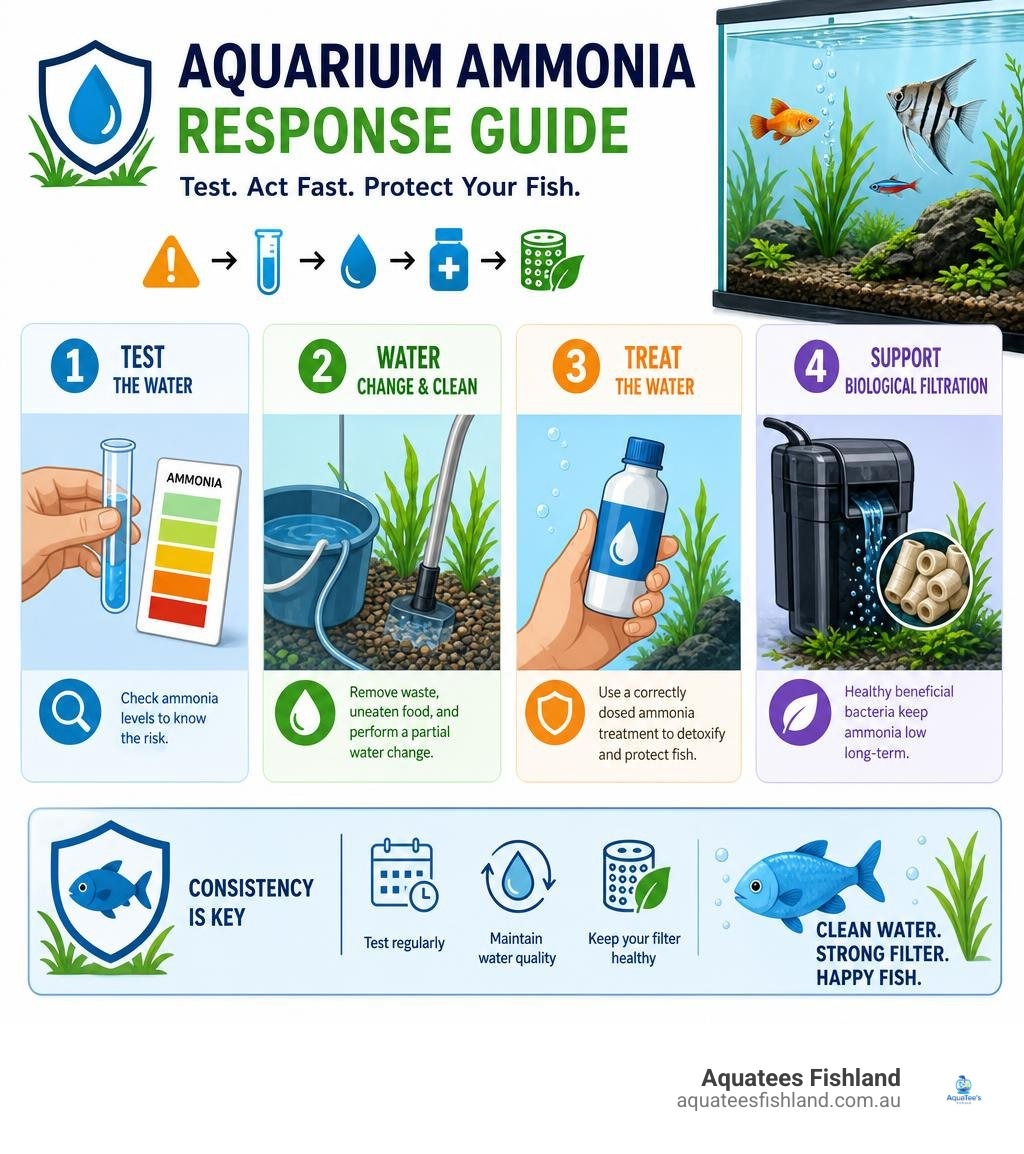
An aquarium ammonia remover can help make toxic ammonia less harmful during a sudden spike, but the fastest response is a clear plan: test the water, perform a partial water change, remove waste, increase aeration, use an appropriate ammonia detoxifier, then support the biological filter. A water change dilutes ammonia, a detoxifier can temporarily reduce toxicity, and beneficial bacteria help process waste over time.
Ammonia problems need two fixes at once. Protect the fish quickly, then work out why the tank’s biological filtration is not keeping up.
Hi, I'm Nemo Sulaiman, part of the eCommerce and warehouse team at Aquatees Fishland. I've spent the past two years helping customers choose aquarium equipment, water treatments and products for common water-quality problems. Ammonia spikes can stress fishkeepers, so in this guide I'll walk you through what to do first, what products can help, and how to prevent the problem from coming back.
What Causes High Ammonia in an Aquarium?
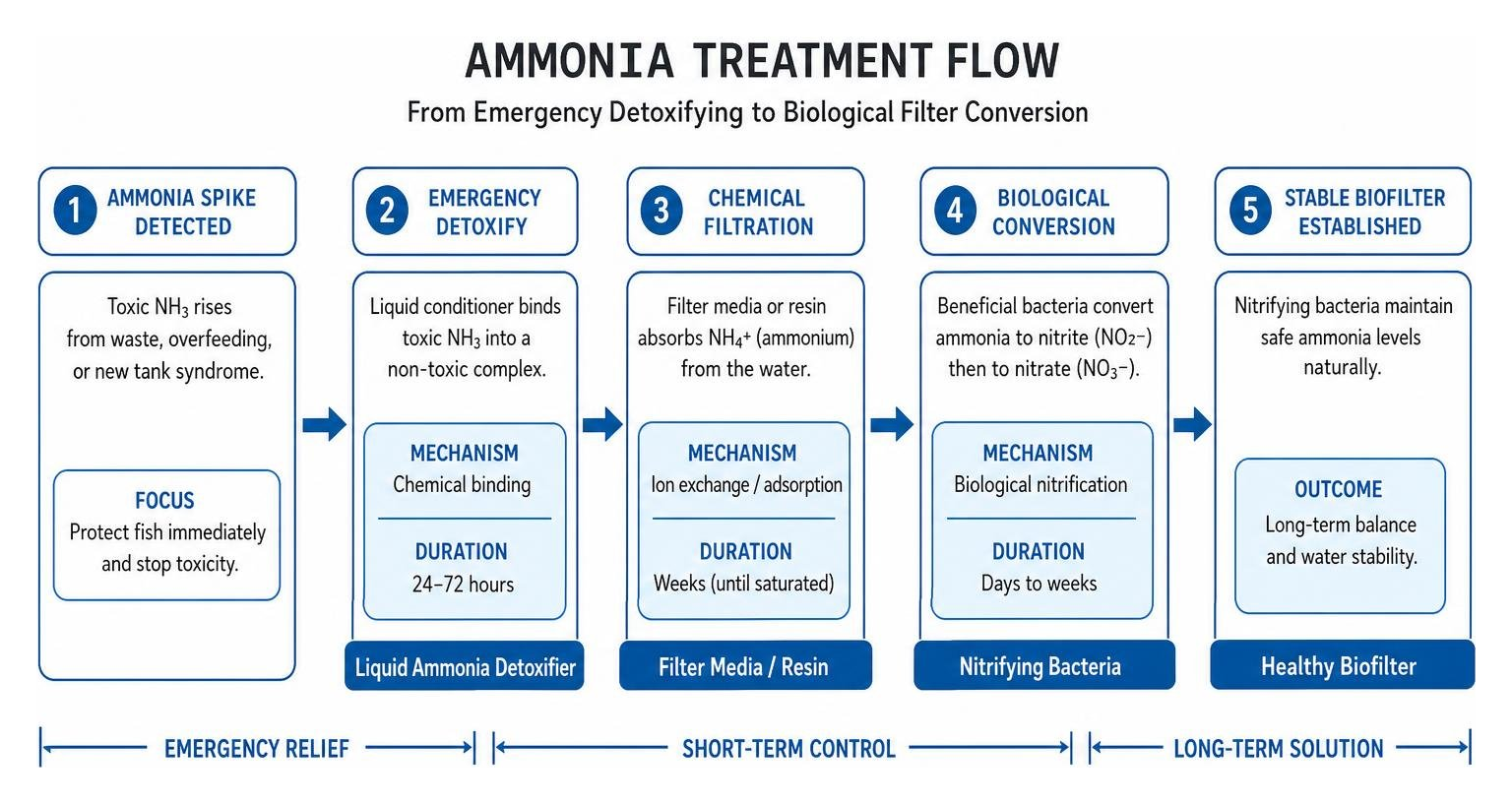
High ammonia in an aquarium usually means waste is being produced faster than the biological filter can process it. Fish waste, uneaten food, decaying plants, dead livestock, overfeeding, overstocking, and immature filter bacteria can all cause ammonia to rise, even when the water looks clear.
Ammonia is part of the aquarium nitrogen cycle. Beneficial bacteria normally convert ammonia into nitrite, then nitrate. If the aquarium is new, under-filtered, or carrying too much waste, that process can fall behind.
For more detail, see our guide to fixing high ammonia. If the aquarium is new, our article on cycling an aquarium explains how biological filtration develops.
Ammonia becomes more dangerous as pH and temperature rise because more total ammonia shifts into toxic un-ionised ammonia, or NH3. Regular testing with a water quality test kit helps you spot the problem before fish show stress.
How to Lower Aquarium Ammonia Quickly
The quickest way to lower aquarium ammonia is to test the water, dilute ammonia with a partial water change, remove waste, increase oxygen, and use an appropriate ammonia detoxifier while the biological filter recovers. Do not rely on one product alone, because the underlying cause still needs fixing.
Follow this emergency process:
- Test the water: Check ammonia, nitrite, nitrate and pH.
- Perform a partial water change: Replace part of the aquarium water with temperature-matched, dechlorinated tap water.
- Remove waste: Siphon uneaten food, fish waste, decaying leaves and any dead livestock.
- Reduce feeding temporarily: Feed lightly or pause feeding briefly if fish are safe to do so.
- Increase aeration: Add an air stone or improve surface movement.
- Use an appropriate ammonia detoxifier: Choose a water treatment suited to your aquarium type and follow the directions.
- Check the filter and biological media: Make sure the filter is running and biological media has not been rinsed in untreated tap water.
- Add beneficial bacteria where appropriate: A bacterial supplement can support the biological filter after cycling issues or filter disruption.
- Retest the water: Keep testing until ammonia and nitrite are under control.
A water change physically reduces ammonia. A detoxifier can temporarily make ammonia less harmful. Beneficial bacteria help process ammonia biologically so the problem is less likely to return.
Aquatees Fishland stocks water treatments and conditioners for aquarium maintenance, including options in our water conditioners range. Suitability varies depending on tank size, livestock, water parameters and manufacturer directions.
Choosing an Aquarium Ammonia Remover
Choosing an aquarium ammonia remover depends on whether you need emergency protection, chemical filtration support, or long-term biological stability. A strong approach combines immediate ammonia control with better filtration and maintenance.
Liquid Ammonia Detoxifiers
Liquid ammonia detoxifiers can temporarily bind or neutralise toxic ammonia forms during sudden spikes. They do not remove the waste source or replace biological filtration, so use them alongside testing, water changes, filter checks and maintenance.
Always follow the product label. Dose rates, repeat dosing, water-type compatibility and test-kit interactions can vary.
Ammonia-Removing Filter Media
Ammonia-removing filter media supports chemical filtration by binding or trapping certain ammonia compounds. Capacity is limited, so replace or regenerate media according to the product’s instructions.
Suitability depends on the aquarium and the media. Some ion-exchange options are mainly suited to freshwater systems and may not perform the same way in marine water.
Beneficial Bacteria
Beneficial bacteria support the nitrogen cycle by helping convert ammonia into nitrite and then nitrate. They are useful for new tanks, unstable aquariums, filter recovery, and situations where biological filtration needs support.
Aquatees Fishland stocks FritzZyme products online in Australia, including FritzZyme 7 in 236 ml, 473 ml, 946 ml, and 3.7 L options. FritzZyme 7 is relevant when freshwater aquariums need help establishing or fortifying biological filtration.
| Treatment | Main purpose | Best used for |
|---|---|---|
| Liquid detoxifier | Temporarily neutralises toxic ammonia | Emergency spikes |
| Ammonia filter media | Removes or binds certain ammonia compounds | Chemical filtration support |
| Beneficial bacteria | Builds biological filtration | New or unstable tanks |
How to Prevent Ammonia Spikes From Coming Back
Preventing ammonia spikes means keeping the biological filter strong enough to match the waste being produced. Once the emergency is under control, focus on the root cause rather than repeatedly dosing water treatments.
Avoid overfeeding, remove decaying plant matter, keep stocking levels appropriate, and perform regular partial water changes. Test ammonia, nitrite, nitrate and pH regularly, especially in new aquariums.
Filter care matters too. Rinse mechanical filter sponges or pads in discarded tank water rather than untreated tap water, and avoid replacing all biological media at once. Beneficial bacteria live heavily on filter media, so removing too much media can weaken ammonia processing.
From what we see when helping customers, ammonia problems usually point to an aquarium where the biological filtration has not caught up with the waste being produced.
Our guide to aquarium beneficial bacteria explains how bacterial colonies support long-term stability. If filtration seems undersized, our article on choosing the best tank filter may help compare filter options for home and office aquariums.
Frequently Asked Questions About Aquarium Ammonia Removers
What is the fastest way to lower ammonia in a fish tank?
The fastest way to lower ammonia is to test the water, perform an appropriate partial water change, remove uneaten food or decaying matter, increase aeration, and use a suitable ammonia detoxifier according to the product directions. Retest to confirm whether the water is improving.
Does an aquarium ammonia remover actually remove ammonia?
Some products detoxify or bind ammonia temporarily, while others physically remove or trap ammonia through chemical filter media. Water changes also dilute ammonia. Check the product instructions so you know which type you are using.
How long does an ammonia remover work?
How long an ammonia remover works depends on the product, dose, tank size, waste load and water conditions. Follow the manufacturer’s directions for dosing, filter media replacement, and testing.
Can I use an ammonia remover during a fish-in cycle?
An ammonia detoxifier can be used during a fish-in cycle to help protect fish while biological filtration develops, provided the product is suitable for that use. Keep testing daily, dose according to instructions, and continue building the nitrogen cycle.
Can beneficial bacteria remove ammonia?
Beneficial bacteria help process ammonia biologically by converting it through the nitrogen cycle. They are not an instant substitute for a water change during a serious spike, but they are important for long-term ammonia control.
Why does my aquarium keep getting ammonia spikes?
Repeated ammonia spikes usually point to a waste or filtration issue. Common causes include overfeeding, too many fish, decaying organic matter, an immature biological filter, damaged filter media, or cleaning routines that remove too much beneficial bacteria.
Can I use an ammonia remover with beneficial bacteria?
Ammonia removers and beneficial bacteria can serve different roles, but compatibility depends on the specific products. A detoxifier may help protect fish during a spike, while bacteria support biological filtration. Always follow product directions.
Should I do a water change if ammonia is high?
Yes, an appropriate partial water change is one of the fastest ways to reduce ammonia concentration. Use dechlorinated, temperature-matched water, avoid shocking the fish, and retest afterwards.
Is ammonia dangerous to fish?
Ammonia is dangerous to fish because toxic un-ionised ammonia can irritate and damage gill tissue and affect normal breathing. Risk depends on concentration, pH, temperature, exposure time, fish species and water quality.
How do I stop ammonia from coming back?
Stop ammonia from coming back by maintaining mature biological filtration, feeding appropriately, avoiding overstocking, removing decaying waste, testing water regularly, and performing routine partial water changes.
How to Keep Aquarium Ammonia Under Control
Keeping aquarium ammonia under control comes down to four habits: test first, act quickly during a spike, fix the biological cause, and maintain the aquarium consistently. An ammonia remover can be valuable in an emergency, but healthy filtration, appropriate feeding and maintenance keep water stable.
Use this final checklist as your routine:
- Test ammonia, nitrite, nitrate and pH with reliable equipment.
- Respond quickly to spikes with a partial water change, waste removal, aeration and a suitable detoxifier.
- Protect beneficial bacteria by cleaning filter media gently in discarded tank water.
- Avoid overfeeding and remove uneaten food before it breaks down.
- Support the nitrogen cycle with appropriate biological media and bacteria products where needed.
For next steps, you can explore:
- Water conditioners for routine treatment and ammonia spike support.
- FritzZyme 7 for freshwater biological filtration support.
- Our guide to fixing high ammonia if your tank keeps testing high.
- Our aquarium cycling guide if the aquarium is new or the filter bacteria may not be established yet.