

Why Your Tank's Water Quality Starts With an Internal Bio Filter
An internal bio filter is one of the most practical tools you can put inside a freshwater aquarium, and understanding what it actually does makes a big difference to how well your tank runs long-term.
What is an internal bio filter?
- It is a self-contained filtration unit that sits inside your aquarium, fully submerged
- It combines mechanical filtration (trapping physical waste) with biological filtration (growing beneficial bacteria that break down toxic ammonia and nitrite)
- Many models also include chemical filtration via activated carbon, and some add aeration to oxygenate the water
- Beneficial bacteria colonise the porous filter media inside the unit, converting harmful ammonia into nitrite, then into the far less toxic nitrate
- They are suitable for tanks ranging from nano setups under 10 litres up to aquariums of 200 litres or more, depending on the model
Here is the thing most beginners miss: the filter is not just cleaning visible debris. The biological layer inside is what actually keeps your fish alive. Without it, toxic compounds build up fast in a closed system like an aquarium, and fish feel that instability immediately.
That invisible biological process, the nitrogen cycle, is what separates a stable, thriving tank from one that constantly has problems. Get that right, and most other issues become a lot easier to manage.
I'm Naim Ibn Nahshid, and through my hands-on work across a wide range of aquarium products and real customer setups at Aquatees Fishland, I've seen how often an internal bio filter is the missing piece in a struggling tank. This guide breaks down everything you need to know to get it working properly for your setup.
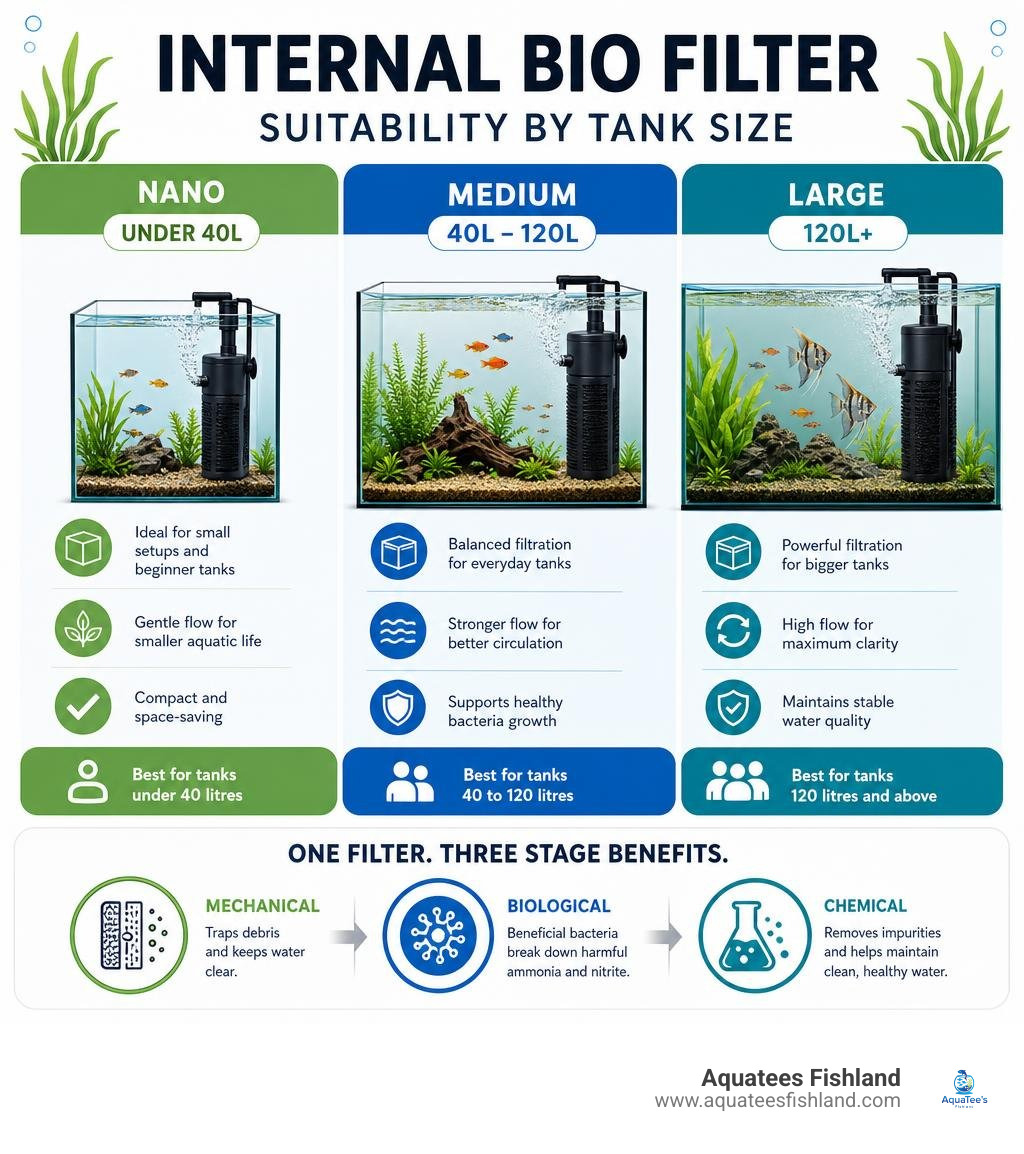
Maximising Your Tank Health with an Internal Bio Filter
An internal bio filter maximises tank health by combining mechanical debris removal, chemical purification, and biological waste conversion in a single, submerged unit. This multi-stage process ensures that solid waste is trapped, dissolved toxins are neutralised, and constant water circulation keeps oxygen levels high.
When we talk about aquarium health, we have to look at how these different stages work together. Mechanical filtration is the first line of defence, physically trapping floating debris like fish waste, plant matter, and uneaten food. This keeps the water looking clear and prevents those solids from breaking down.
Chemical filtration uses materials like activated carbon to bind dissolved impurities. This process removes medication residues, yellow water tint, and unpleasant odours from the water column.
Then comes biological filtration, which is the absolute engine room of your tank. This is where beneficial nitrifying bacteria live. These microscopic helpers break down the invisible, toxic chemical waste produced by your fish.
Finally, the physical movement of water generated by the filter pump is vital. Good water circulation prevents stagnant spots where waste can accumulate.
It also drives gas exchange at the surface, which is critical during hot Australian summers. When water temperatures rise, oxygen levels naturally drop.
Efficient circulation and surface agitation become a literal lifesaver for your livestock during these warm periods.
Using a well-designed Internal Tank Filter is an efficient way to manage this entire process in smaller to medium-sized aquariums. To get this cycle established quickly and safely in a new setup, we often recommend adding a concentrated live bacteria starter.
A formula like FritzZyme 7 introduces the specific strains of active nitrifying bacteria needed to seed your filter media immediately. This drastically reduces the time it takes to make the water safe for your fish.
How Does an Internal Bio Filter Work?
An internal bio filter works by drawing aquarium water through porous media where colonies of nitrifying bacteria process nitrogenous wastes. This biological activity converts highly toxic ammonia into nitrite, and then into less harmful nitrate.
To understand this process, we need to look at the nitrogen cycle. Fish constantly release ammonia into the water through their gills and waste. Ammonia is highly toxic and can quickly damage fish gills and organs.
In a mature filter, a group of beneficial bacteria called Nitrosomonas consumes this ammonia and converts it into nitrite. While that is a step in the right direction, nitrite is still highly toxic to aquatic life.
Fortunately, a second group of bacteria, Nitrobacter, quickly steps in to convert that nitrite into nitrate. Nitrate is much less harmful and is easily managed through regular partial water changes and absorption by live aquarium plants.
For this biological engine to run smoothly, the bacteria need a physical home with a massive amount of surface area. This is why internal filters are packed with highly porous materials like sponges and ceramic media.
The larger the surface area, the more bacteria can colonise the filter, and the more waste they can process. Think of these porous materials as a massive apartment block for your microscopic helpers.
Because you cannot see ammonia or nitrite with the naked eye, regular testing is the only way to know if your biological filter is doing its job. Keeping a reliable testing kit on hand, such as the Sera Ammonia Test Kit, allows you to monitor these invisible levels.
When starting a new aquarium, the natural cycle can take several weeks to establish on its own. To prevent new tank syndrome, you can use a bacterial supplement like Seachem Stability to safely and rapidly build the biological barrier in your filter.
For a comprehensive look at setting up your system from scratch, take a look at our Freshwater Tank Filter Guide 2026.
Comparing an Internal Bio Filter to Other Systems
Internal bio filters offer a compact, leak-proof, and cost-effective filtration solution compared to external canisters or hang-on-back (HOB) systems. Because they sit entirely inside the glass, there is zero risk of water spilling onto your living room floor if a hose comes loose or a seal fails.
Every filtration system has its place in the hobby, and choosing the right one depends on your specific tank setup, budget, and maintenance preferences. Hang-on-back filters are popular for their ease of access, but they can be noisy and require a cut-out in your tank lid.
Canister filters offer massive media capacity but are expensive, bulky, and require careful plumbing. Sponge filters are incredibly safe for breeding tanks, but they lack mechanical power and take up quite a bit of visual space.
Many modern internal bio filters feature a modular design. This means the filter is split into separate, interlocking chambers. You can easily slide out individual sections to clean or replace the mechanical sponges without disturbing the main biological media.
This modular approach provides excellent flexibility, allowing you to customise the media types to suit your current water conditions.
| Filter Type | Placement | Leak Risk | Biological Capacity | Best Suited For |
|---|---|---|---|---|
| Internal Bio Filter | Fully submerged inside the tank | None | Moderate to High | Nano tanks, breeding setups, medium community tanks |
| Sponge Filter | Inside the tank, air-pump driven | None | High (Biological only) | Shrimp, fry, quarantine, and low-flow setups |
| Hang-On-Back (HOB) | Mounted on the aquarium rim | Low to Moderate | Moderate | Small to medium display tanks |
| Canister Filter | Stored beneath the tank in a cabinet | Moderate to High | Very High | Large aquariums, heavily stocked tanks, aquascapes |
For larger or heavily stocked aquariums where an internal unit might not have enough biological capacity, upgrading to an External Filter Pump is often the best path forward.
A robust external system like the Periha EC Canister provides the massive media volume and high flow rates needed to keep larger water volumes stable and crystal clear.
Best Practices for Biological Filtration
Optimising biological filtration requires choosing highly porous media and protecting beneficial bacteria from chemical damage during maintenance. The goal is to maximise surface area while ensuring steady water flow so oxygen-rich water constantly bathes the bacterial colonies.
The choice of filter media directly impacts how many beneficial bacteria your filter can support. Basic plastic bio-balls work well in wet-dry trickle systems but lack surface area for compact internal filters.
Instead, look for highly porous ceramic rings or sintered glass stones. Using a high-capacity biological media like Seachem Matrix provides thousands of square metres of internal surface area per litre, giving your bacteria the ultimate environment to thrive.
The most common mistake beginners make is how they clean their filter. Tap water contains chlorine and chloramines, which are added by municipal water authorities to kill bacteria.
If you rinse your biological media or your Biological Filter Sponge under the tap, you will instantly sanitise the filter. This sanitisation kills off the beneficial bacteria and crashes your nitrogen cycle.
To keep your system safe, check with your local water authority to understand what additives are in your tap water.
To clean your filter safely, follow these steps:
- Always unplug the filter before putting your hands in the tank
- Drain some aquarium water into a clean bucket during your regular water change
- Remove the filter sponges and gently squeeze them in the bucket of tank water to remove excess sludge
- Gently swish your biological media in the same bucket to remove loose debris without stripping away the bacterial biofilm
- Reassemble the filter and place it back in the tank immediately to keep the bacteria wet and active
If your filter has multiple modules, only clean one section at a time. This staggered cleaning schedule ensures that a strong, mature bacterial colony always remains in the uncleaned sections to handle the waste load while the cleaned section slowly recolonises.
Troubleshooting Common Internal Filter Issues
Common internal filter issues like reduced water flow, noisy operation, and water bypass are typically caused by organic debris clogging the mechanical media or impeller. Regular, gentle maintenance of the moving parts and pre-filter sponges quickly resolves these performance drops.
If you notice the water flow from your filter has slowed to a trickle, the culprit is almost always a clogged mechanical sponge. Over time, fish waste and decaying plant matter fill the tiny pores in the sponge, physically blocking the water.
Simply rinsing the sponge in a bucket of old tank water will quickly restore the flow rate.
A noisy, rattling pump is another common issue. This is usually caused by either trapped air bubbles inside the motor chamber or a piece of grit wrapped around the magnetic impeller.
To fix this, unplug the filter, remove the pump head assembly, and pull out the small plastic impeller. Clean the magnetic shaft and the chamber with a soft brush.
Put it back together, and shake the unit gently underwater once plugged back in to release any trapped air.
Water bypass occurs when the filter media is so heavily clogged that the water finds the path of least resistance, flowing around the media baskets rather than through them. This means your water is not actually being filtered.
Keeping a clean, unclogged sponge is essential to prevent this.
For delicate setups like shrimp breeding or fry tanks where standard internal power filters might create too much suction, switching to a high-volume sponge filter like the Aquatees Jumbo Sponge is an excellent way to provide gentle, highly efficient biological filtration.
Frequently Asked Questions About Internal Bio Filters
How often should I clean an internal bio filter?
You should clean your internal bio filter every two to four weeks depending on your tank's stocking level. Always rinse the media in extracted aquarium water rather than tap water to protect the beneficial bacteria.
Can I turn off my internal bio filter at night?
No, you must never turn off your internal bio filter at night. Beneficial bacteria require a constant flow of oxygenated water to survive, and turning the filter off will cause the colony to die quickly.
How do I know if my biological filter is working?
The only reliable way to know if your biological filter is working is by testing your water parameters. A fully functioning filter will show zero ammonia and zero nitrite, with a gradual rise in nitrate.
When should I replace the biological media inside my filter?
You rarely need to replace biological media like ceramic rings or sintered glass unless they are physically crumbling. Sponges can be replaced when they lose their shape, but this should be done in stages to avoid losing bacteria.
Conclusion: Selecting Your Next Internal Bio Filter
Choosing the right internal bio filter involves matching the unit's flow rate and media capacity to your specific tank volume and livestock requirements. Ensuring your filter has adequate space for biological media is the single best step you can take to maintain crystal-clear water and healthy fish.
At Aquatees Fishland, we focus on helping Australian fishkeepers get their systems running properly the first time. Whether you are managing a small nano tank on your desk or a medium community setup in your living room, selecting a reliable internal filter that is easy to maintain will save you hours of frustration down the road.
By keeping your biological media healthy, rinsing your sponges only in tank water, and monitoring your water parameters, you can easily avoid the common pitfalls of aquarium care.
If you are looking for more practical advice on setting up, cycling, or maintaining your aquarium, explore our library of expert guides in the Aquatees Fishland Articles section to help you make informed decisions for your aquatic goals.