

Why Getting Aquarium Lighting Right Makes or Breaks Your Planted Tank
Aquarium lighting for a planted tank is one of the three pillars of a thriving aquascape, sitting alongside carbon dioxide and nutrients as a foundation for healthy plant growth. Light controls how quickly aquatic plants try to photosynthesise, so the right setting depends on your plant choices, tank depth, and whether you are using CO2.
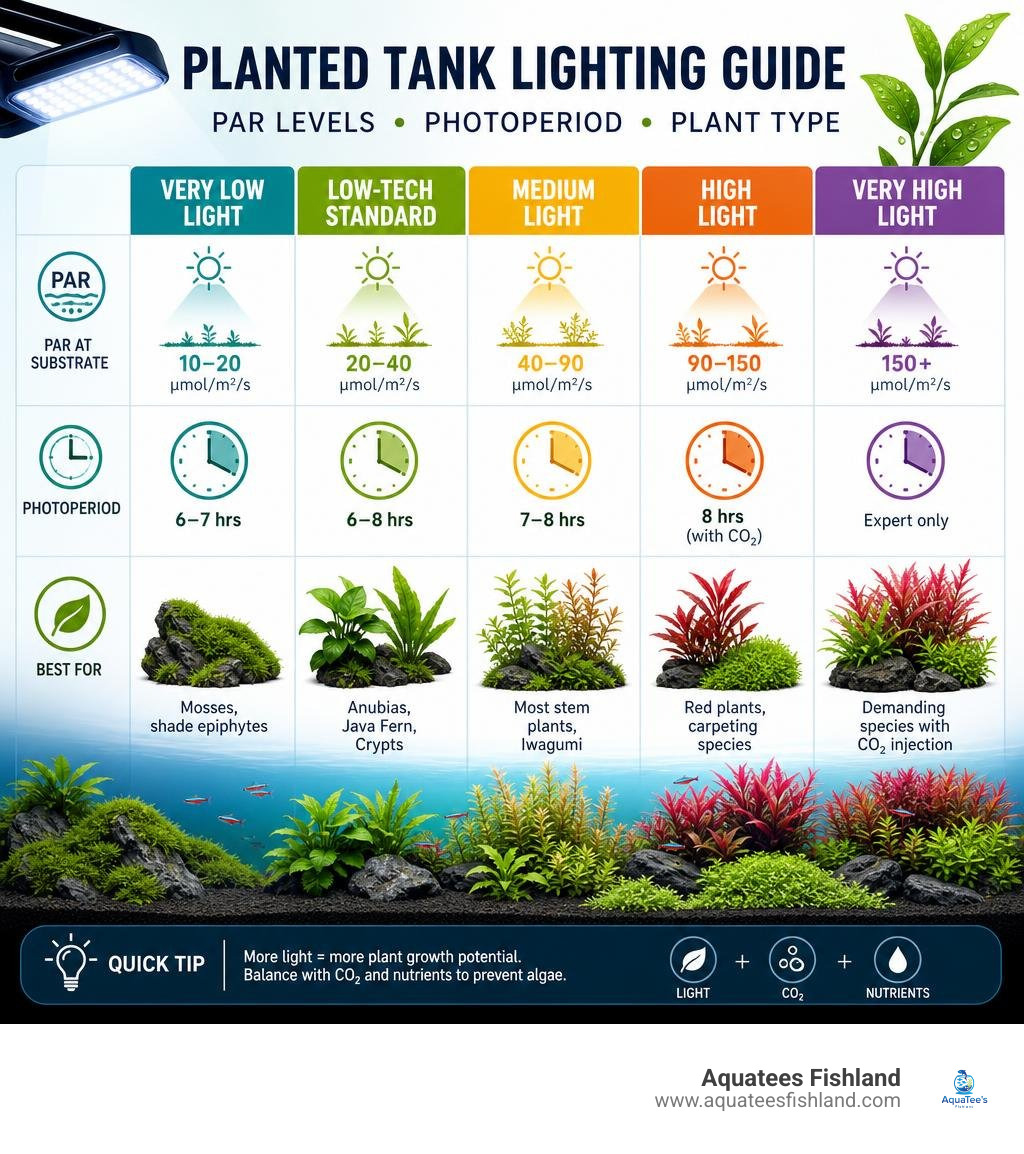
Here is a quick reference to help you get oriented:
| Lighting Category | PAR at Substrate | Photoperiod | Best For |
|---|---|---|---|
| Very Low Light | 10-20 µmol/m²/s | 6-7 hrs | Mosses, shade epiphytes |
| Low-Tech Standard | 20-40 µmol/m²/s | 6-8 hrs | Anubias, Java Fern, Crypts |
| Medium Light | 40-90 µmol/m²/s | 7-8 hrs | Most stem plants, Iwagumi |
| High Light | 90-150 µmol/m²/s | 8 hrs (with CO2) | Red plants, carpeting species |
| Very High Light | 150+ µmol/m²/s | Expert only | Demanding species with CO2 injection |
Too little light and your plants struggle to photosynthesise. Too much light for the available CO2 and nutrients can encourage algae before your plants are established. The goal is not maximum brightness; it is a stable light level your aquarium can support.
I am Naim Ibn Nahshid, and working hands-on with a wide range of aquarium lighting planted tank setups through my role at Aquatees Fishland has given me a practical, ground-level perspective on what actually works versus what just sounds good on paper. Let us walk through how to light your planted tank with confidence.
Choosing the Right Aquarium Lighting Planted Tank Setup
Choose an LED aquarium light that matches your tank length, plant difficulty, and whether you are running CO2. For most beginners, a dimmable low-to-medium LED from the Aquatees aquarium lighting range is safer than buying the brightest fixture available.
Selecting the correct light for your aquarium is not just about finding the brightest bulb on the shelf. In a planted tank, light acts as the primary engine driving plant metabolism. When you choose a light, consider both light intensity and spectrum tuning so your plants can use the energy you are feeding them.
Modern LED technology has completely changed how we light our tanks. Older fluorescent fixtures can grow easy plants, but LEDs are more efficient, slim, controllable, and practical for consistent day/night routines.
For a detailed look at how modern LEDs compare to older systems, you can read our Aquarium Lighting Guide 2026. Selecting a fixture with dimming or suitable output for your tank size lets you start with lower light pressure and increase intensity only as your plants mature.
LED vs Fluorescent Aquarium Lighting for Planted Tanks
LED lighting is the better choice for most planted tanks because it is efficient, compact, cooler-running, and easier to control. Fluorescent lights can still grow easy plants, but they are less flexible for a new planted setup.
| Feature | LED Aquarium Lighting | Fluorescent Aquarium Lighting | Best Choice |
|---|---|---|---|
| Energy use | Lower power use for strong output | Higher power draw over time | LED |
| Heat | Usually runs cooler | Can add more heat near the tank | LED |
| Control | Often supports dimming or programmable schedules | Usually limited control | LED |
| Plant growth | Excellent when matched to tank size and plant needs | Works for low-light plants | LED |
| Replacement | Long service life | Tubes need more frequent replacement | LED |
| Beginner safety | Easier to start low and adjust upward | Less flexible if output is wrong | LED |
For Aquatees customers, the practical takeaway is simple: start with an aquarium LED that suits the tank length and planting style, then use the schedule and intensity conservatively.
Low-Tech vs. High-Tech Aquarium Lighting Planted Tank Requirements
Low-tech planted tanks need moderate light and a shorter, stable photoperiod. High-tech planted tanks can use stronger light, but only when CO2 injection and fertilisation are also consistent.
When planning your tank, decide whether to run a low-tech or high-tech system. Low-tech setups use moderate light, no added carbon dioxide, and slower plant growth. These systems are stable and beginner-friendly because they have a wider margin of error. If you are just starting out, check out our guide on Starting a Freshwater Aquarium.
High-tech setups pair stronger lighting with carbon dioxide injection and regular liquid fertilisation. This can support dense carpets and vibrant red stem plants, but it requires stricter control of light intensity and timing.
| Setup Type | Light Intensity | CO2 Needed? | Fertiliser Demand | Beginner Risk | Best For |
|---|---|---|---|---|---|
| Low-tech planted tank | Low to medium | No | Low to moderate | Low | Anubias, Java Fern, Crypts, mosses |
| Medium planted tank | Medium | Helpful but not always essential | Moderate | Medium | Stem plants and fuller layouts |
| High-tech planted tank | Medium-high to high | Yes | High and consistent | High | Carpeting plants, dense growth, red plants |
For beginners looking to keep things simple, selecting one of the Best Fish Tanks for Beginners and pairing it with a low-tech lighting schedule is the safest route. You can learn more about managing these low-energy setups by reading this low-tech aquarium lighting guide.
PAR, Spectrum, and Coverage for Aquatic Plants
PAR tells you how much plant-usable light reaches your aquarium plants. Spectrum affects plant appearance and photosynthesis efficiency, while coverage determines whether the entire aquascape receives usable light rather than just the centre of the tank.
Watts only tell you how much electricity a fixture consumes, while lumens measure brightness based on human eye sensitivity. PAR (Photosynthetically Active Radiation) is more useful for planted tanks because it measures the light energy plants can use for photosynthesis.
The colour spectrum affects both plant growth and how the aquarium looks. Red and blue wavelengths are efficient for photosynthesis, while a balanced daylight-style spectrum helps fish and plants look natural.
Tank depth and hardscape layout also matter. As light travels through water, intensity drops, and tall driftwood or rockwork can create shaded zones. When selecting your tank, keep these depth dynamics in mind; you can read our Fish Tank Size Guide to understand how different dimensions affect light penetration.
Here is a breakdown of PAR requirements for common plant species at the substrate level:
- Anubias barteri (Anubias): 10 to 30 µmol/m²/s (Very Easy, Low Light)
- Microsorum pteropus (Java Fern): 15 to 35 µmol/m²/s (Very Easy, Low Light)
- Cryptocoryne wendtii (Crypt): 20 to 40 µmol/m²/s (Easy, Low-Tech Standard)
- Taxiphyllum barbieri (Java Moss): 10 to 40 µmol/m²/s (Easy, Highly Versatile)
- Ludwigia palustris (Red Ludwigia): 50 to 90 µmol/m²/s (Medium, Requires Good Light)
- Rotala rotundifolia (Rotala): 60 to 100 µmol/m²/s (Medium, CO2 Recommended)
- Micranthemum 'Monte Carlo' (Monte Carlo): 80 to 120 µmol/m²/s (Medium-Hard, Carpeting)
Even front-to-back coverage helps prevent shaded planting areas, especially around the aquarium substrate where carpeting and foreground plants need consistent light.
Which Aquarium Light Should I Buy?
Buy the light that matches your tank size and plant ambition, not the most powerful light available. For an easy planted tank, choose a reliable LED fixture from the Aquatees lighting range and run it on a conservative 6 to 7 hour schedule at first.
Use this decision matrix when choosing from the Aquatees range:
| Your Goal | Recommended Light Type | Aquatees Range Direction | Starting Schedule |
|---|---|---|---|
| Easy beginner planted tank | Low-to-medium LED | Aquatees LED light models or suitable Dymax LEDs | 6 hours daily |
| Low-tech aquascape | Dimmable medium LED | Dymax plant-focused LED options | 6 to 7 hours daily |
| Red stems or carpeting plants | Stronger plant-focused LED | Dymax Eclipse-X Plant, Plant REX, or similar planted-tank options | 7 hours with CO2 |
| Shallow display tank | Slim LED with even spread | Flexz Ultra Thin-style lighting where suitable | 6 to 8 hours daily |
| Deeper or more demanding layout | Higher-output LED with good coverage | Plant-focused Dymax or Aquatees models matched to tank length | Start dimmed, then adjust |
The Aquatees Aquarium Lighting Collection includes practical options for freshwater and planted displays, including Dymax plant-focused LEDs and Aquatees LED light models in different configurations. Look for a fixture that suits your tank length, spreads light evenly from front to back, and gives you enough intensity without forcing a high-tech setup before you are ready.
Dymax options such as the Eclipse-X Plant, Plant REX LED lights, Flexz Ultra Thin LED lights, and Space-X LED lights are especially relevant for hobbyists who want reliable aquarium LEDs from the Aquatees range. Match the fixture to your tank size and planting style, then use a conservative schedule at first.
Achieving Balance: Your Aquarium Lighting Planted Tank Guide
Balance comes from matching light intensity, photoperiod, CO2, fertiliser, plant mass, and maintenance. If one part is pushed too far ahead of the others, the tank becomes harder to manage.
In planted aquariums, stronger light increases plant demand for carbon and nutrients. If you raise intensity or duration, make lighting changes gradually and watch plant response before adjusting again.
Quick Balance Checklist
| If You Increase... | You Also Need More... | If You Do Not Adjust... |
|---|---|---|
| Light intensity | CO2, nutrients, plant mass | Algae pressure increases |
| Photoperiod | Maintenance consistency | Green spot, hair algae, or green water may appear |
| Plant density | Fertiliser and trimming | Older leaves may yellow or melt |
| CO2 injection | Stable timing and circulation | Plants may still struggle despite strong light |
To keep lighting balanced:
- Start with a conservative photoperiod: Keep lights on for 6 to 7 hours daily during the first few weeks of a new setup.
- Dim your lights if needed: If your fixture allows intensity adjustment, run it at 50% to 60% initially, then increase slowly as plant mass develops.
- Use a timer: Keep the light schedule consistent every day.
- Adjust gradually: Change intensity or duration every 1 to 2 weeks, not every day.
To explore fixtures, brackets, and accessories, browse the Aquatees Aquarium Lighting Collection. If you are designing a planted layout, the Aquatees Aquascaping Collection can help with hardscape and plant placement.
Common Beginner Lighting Mistakes
The biggest beginner mistakes are using too much light, leaving the light on too long, ignoring CO2 and nutrients, and buying a fixture that does not match the tank depth or plant selection.
From a practical store-floor perspective, lighting problems often appear as green film, hair algae, pale new growth, or plants melting after the first few weeks.
| Mistake | What It Looks Like | Better Approach |
|---|---|---|
| Running lights 10 to 12 hours | Green glass, hair algae, tired-looking plants | Start at 6 hours daily |
| Buying the strongest light first | Fast algae before plants establish | Choose controllable LED output |
| No timer | Inconsistent plant response | Use a fixed daily schedule |
| High light without CO2 | Algae and pale new growth | Stay low-tech or add proper CO2 |
| Shaded hardscape ignored | Plants fail in corners or behind wood | Place low-light plants in shaded zones |
| Changing settings too often | Tank never stabilises | Adjust slowly every 1 to 2 weeks |
What is the ideal photoperiod for an aquarium lighting planted tank?
Most planted aquariums should run lights for 6 to 8 hours per day. New low-tech tanks should usually start at 6 hours, while mature high-tech tanks can often run 7 to 8 hours if CO2 and nutrients are stable.
Extending the light cycle beyond this window rarely improves a low-tech tank. In high-tech aquariums, 7 to 8 hours is usually enough because added CO2 helps plants process light energy more efficiently. A reliable timer is one of the simplest ways to keep the schedule stable.
How do I prevent algae while maintaining plant growth?
Prevent algae by reducing excess light pressure, keeping the schedule consistent, avoiding overfeeding, and choosing aquarium-care products from the Aquatees range when extra support is needed.
If algae starts appearing on leaves or glass, first reduce either light intensity or photoperiod. Reducing intensity is often more effective than only shortening the day because it lowers the total light pressure on the system.
Floating plants such as Red Root Floaters or Frogbit can also diffuse light and shade slower-growing plants where appropriate. If algae becomes stubborn, review the lighting schedule before reaching for treatment, then use suitable support from the Aquatees Aquarium Care Collection.
Troubleshooting Aquarium Lighting Problems
Diagnose lighting problems by looking at the plant response and algae type. Most issues can be improved by adjusting intensity, shortening the photoperiod, or choosing a better-matched Aquatees lighting option.
| Problem | Likely Cause | What to Try First | Aquatees-Focused Support |
|---|---|---|---|
| Hair algae | Too much light for available CO2/nutrients | Reduce intensity or photoperiod | Review lighting and aquarium-care options |
| Green water | Excess light plus nutrient spike | Shorten the lighting schedule | Improve maintenance supplies from aquarium care range |
| Plants reaching upward | Light may be too weak or poorly spread | Improve coverage or move plants | Choose a better-matched LED fixture |
| Lower leaves melting | Shading or nutrient deficiency | Trim, replant tops, improve fertilisation | Pair lighting with substrate and care products |
| Red plants stay green | Not enough intensity or CO2 | Increase light slowly only if balance is stable | Consider plant-focused Dymax lighting |
| Algae on slow plants | Too much direct light on Anubias or Java Fern | Move to shade or reduce intensity | Use hardscape and plant placement wisely |
How do I balance lighting with CO2 and nutrients?
Match the strength of your light to the carbon and fertiliser your plants can actually access. Strong light without enough CO2 and nutrients creates stress, while moderate light with steady care is easier for beginners to manage.
When plants are exposed to stronger light, they use available carbon and fertiliser faster. If these inputs are not available, plants may show yellowing, pinholes, or melting. Keep the light level aligned with your CO2 plan, fertiliser routine, and plant difficulty.
Frequently Asked Questions
How many hours should a low-tech aquarium light run?
A low-tech aquarium light should usually run for 6 to 8 hours per day, with new planted tanks starting closer to 6 hours. This gives plants enough usable light without pushing the tank too hard early on.
Can cheap LED lights work for low-tech planted tanks?
Yes. Affordable LED lights can work for low-tech planted tanks if they provide even coverage and are not run for too many hours. Because low-light plants like Anubias and Java Fern only require modest light, you do not need an expensive high-powered fixture to grow them successfully.
Does color temperature (Kelvin rating) really matter for plant growth?
Kelvin rating matters more for how the aquarium looks than whether plants can grow. A daylight-style full-spectrum aquarium LED is usually the best practical choice, with 6000 K to 8000 K offering a clean, natural look.
Should beginners choose low, medium, or high light?
Beginners should usually choose low-to-medium light because it gives plants enough energy to grow without making algae problems difficult to control. It supports hardy plants and gives you time to learn the tank before moving into demanding high-light species.
Is a dimmable aquarium light worth it?
Yes. A dimmable aquarium light is worth it because you can start gently, reduce algae pressure, and increase intensity only when the plants are ready. This is especially helpful if you may later use the fixture for a more advanced aquascape.
Finding the Best Aquarium Lighting Planted Tank Solutions
Selecting the correct aquarium lighting for a planted tank is the key to unlocking vibrant plant growth while keeping the setup manageable. Whether you are running a simple low-tech tank or a high-energy aquascape with carbon dioxide, matching your light intensity to your system's capability creates a more stable result.
At Aquatees Fishland, we help Australian hobbyists choose lighting that suits their tank size, plant choice, and experience level. From practical LED fixtures to plant-focused lighting options, the goal is to choose equipment that supports your aquascape without overpowering it.
If you are ready to upgrade your setup or start a brand-new planted project, explore our curated collections online:
- Browse our Aquatees Aquarium Lighting Collection to find the right fixture for your tank depth.
- Create a planted layout with rocks and soils from our Aquatees Aquascaping Collection.
- Keep lighting-related algae issues under control with support from our Aquatees Aquarium Care Collection.